Christmas is still eight months away, but artificial tree maker Lou Liping is already worried about a bad holiday season due to the Iran war.
Lou’s company, Kitty Christmas Factory, has been making artificial trees for the U.S. and European markets for nearly three decades. Her facility is based in the city of Yiwu, known as China’s Christmas capital.
“Many customers … are holding off on orders,” she told CNBC last Friday at her showroom in the city’s international expo center. The center houses hundreds of manufacturers that contribute to the country’s vast production of the world’s artificial trees, tinsel, ornaments and other decorations.
An estimated 87% of Christmas decor sold in the U.S. is sourced from China, according to the American Christmas Tree Association, with much of it from Yiwu.
Lou said the disrupted shipping in the Strait of Hormuz and high oil prices due to the Iran conflict have raised her costs per tree by 10%. The base material of her trees is PET plastic derived from oil. The price of the PET in her artificial pine needles is up 5%, and the cost of the plastic used as packaging for shipments is up 15%, she said.
Lou said her revenue is down roughly 12% because of the lost orders.
Yiwu’s factories normally gear up in the spring to make sure that their products are on store shelves for the Christmas shopping season.
“The war happened at a bad time — right when we need to get our shipments out,” tinsel maker Yun Zhuomei told CNBC from her booth at the expo center. “It’s very painful for us manufacturers.”
Yun said plastic prices for her tinsel are up as much as 40%.
Chen Lian, who makes Christmas lights, said she fears further price increases, with suppliers all moving up delivery schedules to accommodate customers worried about transport delays.
“Everyone needs to deliver between May and August so demand is concentrated,” Chen said. “Material prices are bound to go up.”
To adjust, artificial tree maker Lou said she has accelerated shipments. And when her contracts with customers allow, she passes on some cost. For next year, she said she aims to design a wider variety of lower-end trees so more people can afford her products.
But for this season, Lou said American shoppers will likely be stuck paying at least 15% more.
“The price of Christmas trees in the U.S. will definitely go up,” she said. “It is unavoidable.”
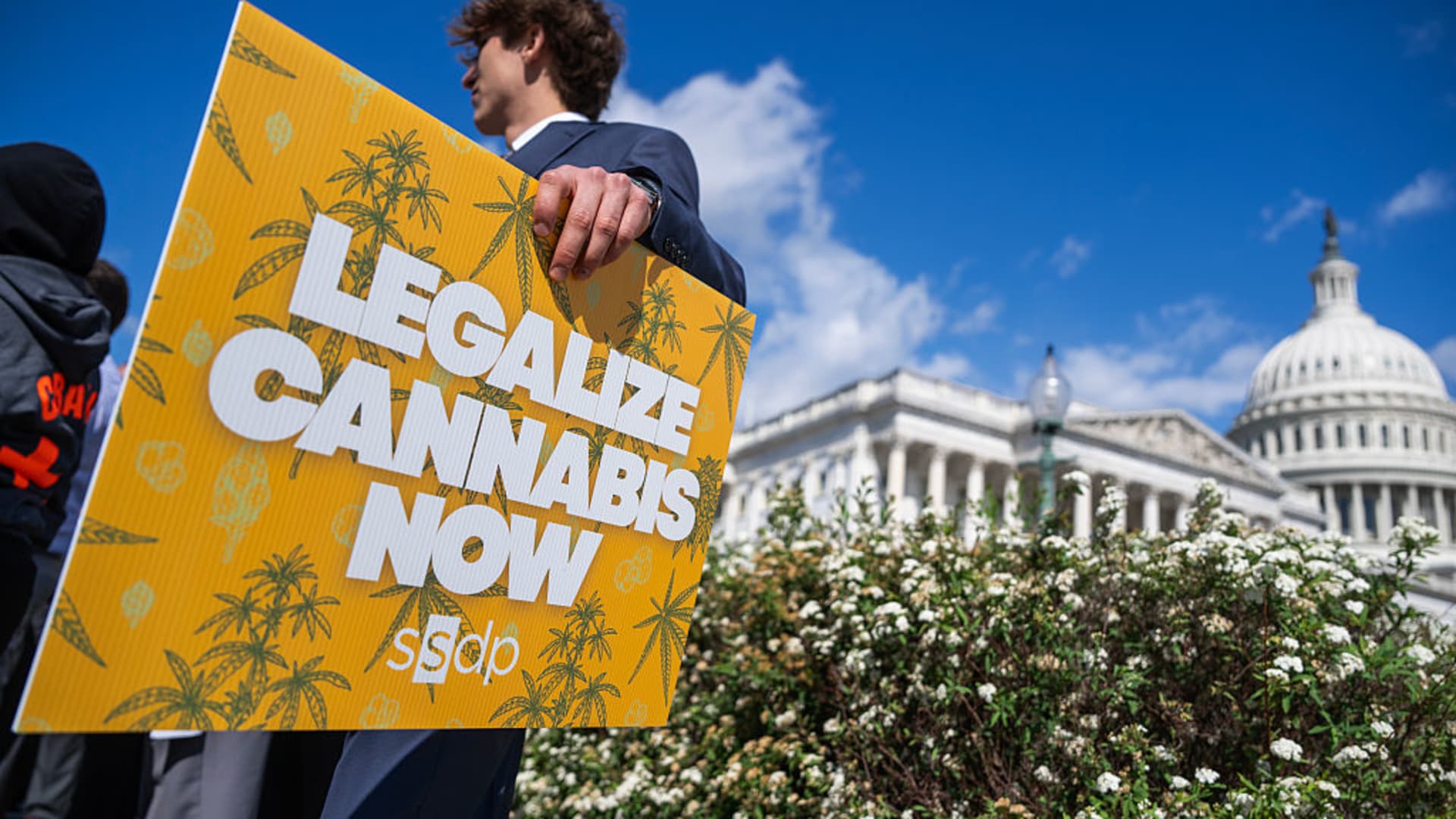
Advocates attend a news conference about the “impact of incarcerating those charged with marijuana-related offenses,” and policy reform ideas, outside the U.S. Capitol on April 20, 2026.
Tom Williams | CQ-Roll Call, Inc. | Getty Images
A White House executive order on psychedelics, signed by President Donald Trump on Saturday, aims to speed up research on drugs like psilocybin, MDMA and ibogaine, helping to legitimize an industry that’s long lived largely underground.
But it also raises a broader question: Will psychedelics fall victim, like cannabis has, to a slow-moving federal process?
The latest executive order comes roughly four months after an effort by President Trump to reschedule cannabis, opening the door to greater research and investment opportunities. But since that directive, progress to reclassify cannabis has largely stalled, with the Drug Enforcement Administration review still ongoing and no final decision on moving marijuana from Schedule I to the lesser Schedule III.
The delay reflects how drug policy often slows once it enters interagency review, where scientific evaluation, legal standards and politics meet.
“The process has certainly been slow and frustrating for stakeholders when you consider they have spent decades fighting marijuana’s outrageous 1970s-era misclassification,” said Shawn Hauser, partner at cannabis law firm Vicente LLP.
Vicente LLP also serves as legal counsel for the National Compassionate Care Council, or NCCC, a coalition of health-care stakeholders focused on evidence-based cannabis policy.
The psychedelics order, however, focuses on research acceleration rather than legalization. It directs agencies like the U.S. Food and Drug Administration to expand clinical trials and “Right to Try” access for patients with serious mental health conditions, while leaving drug scheduling unchanged.
AtaiBeckley is among a number of psychedelics-focused drug developers whose stock is rallying since the order was signed over the weekend, up roughly 25% Monday. Several smaller-market cap stocks also jumped, including Compass Pathways, Definium Therapeutics and U.S.-listed shares of Cybin.
Hauser said the recent psychedelics order reflects a broader shift in Washington toward a medical-first framework and could mark a path forward for cannabis rescheduling.
“The science-, patient-, health-care-first approach is winning in Washington right now,” she said.
“The psychedelic pathway — built on physician-led protocols, clinical research and compassionate use frameworks — is actually a model cannabis advocates should be studying and adopting more aggressively,” Hauser said.
Safety first
Trump’s psychedelics measure has drawn particular attention for its inclusion of ibogaine, a powerful, naturally occurring psychoactive compound with long-standing safety concerns.
The drug is being studied for its applications with post-traumatic stress disorder, depression and addiction, but cardiac risks flagged by Nora Volkow of the National Institute on Drug Abuse remain a major barrier.
That tension is heightened by the expansion of “Right to Try” access, a federal law allowing patients diagnosed with life-threatening diseases or conditions to try experimental drugs when no other treatments work. This distinction typically applies only after Phase I trials are successful.
Ibogaine has struggled to meet that criteria, since most of the research into the drug has been conducted outside the U.S.
Psychedelic industry leaders say the order is meaningful, but the full impacts are still unknown until implementation catches up to prove scientific value.
“The opportunity now is not hype, it’s execution: rigorous science, disciplined safety standards, physician-led protocols and real-world outcome data,” said Tom Feegel, CEO of clinical neurohealth center Beond.
Beond, based in Cancun, Mexico, specializes in ibogaine therapy.
Feegel added that while the executive order signals legitimacy at the highest level of government, the next phase is critical.
Psychedelics still lack a commercial market, though clinical-stage developers, like AtaiBeckley, Compass and GH Research, are emerging. Many prioritize research around less controversial psychedelics like psilocybin and MDMA derivatives for mental health treatment.
U.S. states have been weighing the space, too. Colorado advanced regulated psychedelic access for its residents in 2022, while a Massachusetts ballot measure failed in 2024 with 56% of voters rejecting the access.
Cannabis, by contract, already has a multibillion-dollar adult-use industry across dozens of states, giving it a significant head start even as federal rescheduling remains unresolved.
Hauser argued the two industries are ultimately reinforcing one another.
“The two regulatory tracks aren’t in conflict,” she said. “Both are advancing the broader legitimacy of plant-based alternative medicines, and the infrastructure being built for one will inevitably support the other.”
A view shows a second-generation R1S at electric automaker Rivian’s manufacturing facility in Normal, Illinois, on June 21, 2024.
Joel Angel Juarez | Reuters
A tornado damaged part of Rivian Automotive‘s factory in central Illinois over the weekend, according to a message sent to employees Sunday night by CEO RJ Scaringe that was viewed by CNBC.
The tornado touched down on the plant, Scarigne said. The affected area was being used for parts storage and logistics for Rivian’s upcoming R2, which is a crucial product for the company that’s expected to be on sale this spring.
Scaringe said operations in the damaged area are expected to resume this week, while other major portions of the plant, such as its assembly lines, are operating as planned. No injuries have been reported as a result of the incident, according to a company spokeswoman.
“While Building 2 has sustained damage and is closed for the time being as we complete our assessments, I am incredibly relieved to share that there were no injuries at our plant,” Scaringe said in his message to employees.
Scaringe said the company would “share more information as it becomes available, but for now, our priority is ensuring our Normal [Illinois] team is safe and supported.”
Apparent photos posted online of the aftermath, which was first reported by TechCrunch, showed damage to the roof and at least one wall of the recently constructed building.
The National Weather Service reports the factory was hit amid a “significant tornado outbreak” that occurred Friday across the upper Midwest. Confirmed tornadoes near the factory Friday night were classified as EF1, with estimated peak winds of 100 mph, according to NWS.
A Jersey Mike’s restaurant in Walnut Creek, California, Nov. 21, 2024.
David Paul Morris | Bloomberg | Getty Images
Jersey Mike’s has confidentially filed for an initial public offering, the company said Monday.
The announcement comes more than a year after Blackstone bought a majority stake in the sandwich chain in a deal that reportedly valued Jersey Mike’s at roughly $8 billion.
After the Blackstone deal closed, Jersey Mike’s tapped former Wingstop CEO Charlie Morrison to helm the company. Morrison led the chicken wing chain for a decade, ushering it through its own IPO and a period of historic growth.
With more than 3,000 locations nationwide, Jersey Mike’s is the second-largest hoagie sandwich chain in the U.S., trailing only Subway.
Jersey Mike’s reported revenue of $309.8 million in 2025, up 10.6% from the prior year, according to franchise disclosure documents. The chain also reported net income of $183.6 million in 2025, down from the prior year’s net income of $238.8 million.
Founder Peter Cancro began working at a Jersey Shore sandwich shop at age 14 in 1971; four years later, he pulled together enough money to buy Mike’s Subs. Cancro later changed the name and began franchising the chain. Until the sale to Blackstone, he was the outright owner of Jersey Mike’s.
The confidential filing is the first step for Jersey Mike’s to be publicly traded. If it goes public, it will mark the first restaurant IPO since Black Rock Coffee Bar’s offering in September.
The market for initial public offerings has been tepid, although that could change this year. Market volatility, economic uncertainty and recent poor performance among IPO stocks has led to a backlog of listings. However, several blockbuster IPOs, such as the SpaceX offering that could value the company at $1 trillion, are anticipated in the coming months.
Correction: Jersey Mike’s reported revenue of $309.8 million in 2025. A previous version of this article misstated the amount.
Delta A350 fleet renderings with the next-generation Delta One suite cabin.
Courtesy: Delta
Delta Air Lines on Monday unveiled an updated Delta One suite for some of its longest-haul planes, marking its first refresh of the top-tier seat in a decade as airline competition for well-heeled travelers ramps up.
The new suites, which Delta said will debut on its Airbus A350-1000 aircraft in 2027, will include beds that are three inches longer than the older suites and a new pillow-top cushion. The new design will give travelers more leg and knee room, said Mauricio Parise, Delta’s vice president of brand experience.
“Most customers are side sleepers,” and the new designs could accommodate them, he said.
Delta had customers test the new suites out for “hours” at the company’s headquarters, Parise said.
Delta A350 fleet renderings with the next-generation Delta One suite cabin.
Courtesy: Delta
The airline’s Delta One business class cabin debuted nearly a decade ago on the A350s, featuring lie-flat beds, doors and a “do not disturb” button.
“We were a first mover, [and] started flying with doors in 2017,” Parise said. “There is an element of improvement.”
The A350-1000s, which are dedicated to long-haul flights, will have 50 of the suites.
The changes come as industry profit leader Delta and other airlines are refreshing their cabins, adding more expensive — and profitable — premium seats as wealthier customers continue to drive results.
The company said that premium ticket revenue, from first class and other more expensive options compared with coach, was up 14% in the first quarter over last year. Main cabin revenue, meanwhile, increased for the first time since late 2024.
Delta’s rival, United Airlines, showed off its new long-haul Polaris suite at the carrier’s hangar at Los Angeles International Airport last month, along with a slew of other products aimed at giving travelers more chances to pay up for additional space, ranging from a three-seat coach row that converts into a bed to both lie-flat and premium economy seats on narrow-body Airbus jets.
Revolution Medicines‘ drug for pancreatic cancer succeeded in a highly anticipated Phase 3 trial, almost doubling the typical length of survival and slashing the risk of death by 60% versus chemotherapy, the company said Monday.
RevMed said its daily pill, daraxonrasib, met all primary and secondary endpoints in a trial of people whose cancer had already progressed on another treatment. People who took daraxonrasib typically lived for 13.2 months versus 6.7 months for people who took chemotherapy, an increase of 6.5 months, RevMed said in a press release.
“These are dramatic, practice-changing outcomes, and our focus now is moving quickly to bring this potential new treatment option to patients who urgently need new treatment,” RevMed CEO Mark Goldsmith said in an interview.
Goldsmith called the results “unprecedented,” saying no drug has shown an overall survival benefit greater than one year in a Phase 3 trial for pancreatic cancer. The company plans to soon seek Food and Drug Administration approval using a Commissioner’s National Priority Voucher, which grants a review within a matter of months.
RevMed’s pill could bring a new option for people with pancreatic cancer, an aggressive disease that has the lowest five-year survival rate of any major cancer, at 13%. Daraxonrasib broadly targets RAS mutations, which drive tumor growth and are found in about 90% of pancreatic cancer cases.
“These results usher in a new era of RAS-targeted medicines for pancreatic cancer, which has been exclusively treated with cytotoxic intravenous chemotherapy,” Goldsmith said.
For patients, these results are “truly transformational,” said Dr. Shubham Pant, professor of gastrointestinal medical oncology at The University of Texas MD Anderson Cancer Center. Pant said he’s been involved in numerous other studies that have failed, and said previous positive trials extended survival by a few weeks or months.
He’s been involved in trials for RevMed’s daraxonrasib since its early days, and choked up multiple times when describing the results and what they mean for patients, including one who participated in the pivotal trial that Pant had seen just before the interview.
“Today, I’m just, I’m just thankful,” Pant said. “That’s all I can say. And you know, just seeing patients in my clinic today, I’ve got a busy clinic today, and I’m just thankful.”
Daraxonrasib gained more attention last week, when former Republican Sen. Ben Sasse, who was diagnosed with pancreatic cancer late last year and given only months to live, shared his experience taking the drug in an interview with The New York Times. He told the Times that Pant is his doctor.
Sasse said his tumors have shrunk 76% since he started taking the drug, but said it causes “crazy” side effects like a facial rash. His face appeared to be peeling during the interview.
RevMed’s CEO Goldsmith said the company can’t comment on any individual patient, but that a rash is a known side effect and one that’s generally manageable. Pant couldn’t speak to the specifics of Sasse’s case, but said the majority of patients in previous trials of daraxonrasib did experience a rash, though less than 10% of them developed a “dramatic” rash. He said strategies like stopping the drug temporarily or treating with antibiotics can help.
“Honestly, since our journey three years ago, we are getting better at managing these side effects, and I think we keep on getting better at managing side effects,” Pant said.
RevMed on Monday said the drug showed a manageable safety profile in the pivotal study and that no new concerns were observed. The full results will be disclosed at a medical meeting.
The company will seek approval for second-line treatment, or in patients whose cancer has already spread while taking another drug. It’s conducting a Phase 3 trial for newly diagnosed patients.
Daraxonrasib could become a foundation that can be built upon and used in combination with other drugs, said Dr. Andrew Aguirre, associate director of the Hale Family Center for Pancreatic Cancer Research and co-director of the Center for RAS Therapeutics at Dana-Farber Cancer Institute. The results are a “whopping improvement” to be “incredibly excited about as really a foundation,” he said.
“And honestly, it’s reason for optimism for the whole field that targeting RAS in this patient population, and hopefully many other contexts for pancreatic cancer and many other difficult-to-treat diseases is going to have real benefit for patients and be something that we can continue to expand and use in combination,” Aguirre said.
Revolution Medicines shares jumped more than 30% following release of the results Monday. Its stock has climbed about 274% in the last year, in part because it has long been seen as an acquisition target.
Monday’s stock move brings the company’s market value to more than $26 billion. Goldsmith said the company is focused on preparing for approval and launch of its drug, rather than any potential acquisition.
In an aerial view, the Netflix logo is displayed above Netflix corporate offices on October 7, 2025 in Los Angeles, California.
Mario Tama | Getty Images
There’s a love affair on Wall Street between investors and streaming.
The romance started about a decade ago when consumers began cutting the cord with cable TV bundles en masse in favor of direct-to-consumer streaming apps. However, where investors were once enamored with subscriber growth, rewarding companies that were able to expand their consumer reach, their attentions have now shifted toward profitability.
To meet this new expectation, streaming companies have raised the prices of their services, cracked down on password sharing and delved into the ad-supported space. It’s also sparked the likes of Paramount Skydance to seek out the acquisition of Warner Bros. Discovery for its extensive library of content and top-tier streaming service, HBO Max, in order to compete.
While streaming continues to drive media stocks, especially around quarterly earnings, it’s not clear when — or if — it will start driving profits for the smaller players.
“Is streaming a good business?” Robert Fishman, senior research analyst at MoffettNathanson, posed in a March research note to investors. “We raised and debated this critical question over the years leading us to determine the answer is yes, albeit only for those services with sufficient scale.”
For legacy media companies, streaming has yet to fully supplant the profits and advertising revenue of linear TV. Of course, both of those metrics have been in decline for companies like WBD, Paramount and its peers.
In response, streamers have largely raised subscription prices for consumers, begging the question of where the ceiling is for streaming costs. Between higher fees and the sheer number of services needed in order to have access to all content, consumers are starting to balk.
Still, with these continuous linear TV declines, investors cling to streaming as a bright spot, especially for companies that have made it profitable. Disney has been among the steadiest of legacy media companies when it comes to a profitable streaming business, but Paramount and WBD have seen profitable quarters and Comcast’s Peacock is narrowing losses.
“With streaming no one’s reporting sub numbers anymore, because now it’s all about profitability,” Doug Creutz, senior research analyst at Cowen, told CNBC. “And that’s the metric by which these these businesses are being judged. It’s, you know, can you get to 10% operating profit? Can you get 15%? Can you get 20%? Can you get 25%? Can you get to where Netflix is?”
Netflix reported operating margin of 29.5% in 2025. Meanwhile, Disney, for example, guided investors to an operating margin for its direct-to-consumer business of 10% in fiscal 2026.
Workers prepare a large sign advertising a Disney movie while San Diego prepares to host thousands of visitors for Comic-Con International, in San Diego, California, on July 22, 2025.
Mike Blake | Reuters
“This is the big question mark that all these companies face,” Creutz added. “You had a linear business that was really profitable and it’s gone away, and is the streaming business ever going to be that profitable?”
‘No streamer comes close to Netflix’
The leader in the space is uncontested.
Netflix was early to the streaming game, scooping up a number of cord cutters with its significantly cheaper online alternative to pricey cable packages. The streaming giant has since grown its library through deals with Hollywood’s studios and by wading into original content.
Being among the first to the space meant a massive audience for Netflix. In January, the company announced it had reached 325 million global paid customers.
“As we think about global scale, the ability to spread the content spend and other fixed streaming costs over a much larger subscriber base leads to a more meaningful streaming profit opportunity,” Fishman wrote. “On that front, no streamer comes close to Netflix.”
In the eyes of Wall Street, Netflix is the gold standard. But competition for viewership is growing and now includes YouTube, TikTok, other social media as well as live events and gaming — all jockeying for consumers’ time.
And even the industry leader isn’t immune to the challenges of the streaming business.
In 2022 Netflix reported its first quarterly subscriber loss in more than a decade, dragging down its stock price. The media giant responded with a series of changes to its business model, most notably the addition of a cheaper, ad-supported tier.
Netflix no longer reports quarterly subscriber counts, and Disney has since followed suit as the industry refocuses on profits. (Disney also stopped breaking down the revenue and operating income for other parts of its entertainment business, including linear TV.)
But analysts agree that the comparison of Netflix to traditional media players isn’t exactly apples to apples. After all, Disney, Comcast, Warner Bros. and Paramount aren’t just streamers. These companies still have linear TV businesses as well as robust theatrical divisions. And some have other, even more lucrative pieces of their empires, including merchandising, theme parks, hotels and cruise lines.
The Paramount booth is shown on the convention floor during the opening day the of Comic-Con International in San Diego, California, U.S. July 24, 2025.
Mike Blake | Reuters
It’s only recently that Netflix has branched out from its content-only strategy to launch its own merchandising and live event businesses.
“They don’t have the decline of legacy media to offset,” Alicia Reese, senior vice president of equity research at Wedbush. “They don’t have theatrical to worry about.”
The result is traditional media companies that are often sized up against what a nontraditional tech company has been able to build in the streaming arena.
How much is too much?
Both Netflix and traditional media companies have raised prices for their streaming platforms over the last year in an effort to boost revenue and justify high content spending.
While consumers groan at the sight of these price increases and at being locked out of accounts they previously borrowed due to password sharing crackdowns, Wall Street applauds such measures.
“We think Netflix is positioning for substantial growth in global advertising, while its latest price increases could provide a meaningful boost to profitability this year,” Reese wrote in a research note published Friday.
Netflix is scheduled to report its quarterly earnings on Thursday, weeks after announcing yet another a price increase across its subscription tiers, including its cheapest plan with ads.
“While Netflix has consistently raised pricing across tiers, our analysis suggests U.S. revenue per streaming hour is one of the lowest among its peers, suggesting further pricing runway going forward,” Matthew Condon, analyst at Citizens, wrote in a research note published last month.
The majority of streamers offer several plans, ranging from a cheaper ad-supported option to an ad-free standard service and then a higher-priced and higher-quality version.
To ease some price burden, streamers have also started to offer bundles of their services at a discount, further suggesting they could be finding customers’ limits.
The difference in pricing of the ad-supported and ad-free tiers varies from streamer to streamer, but typically an ad-supported service ranges from $7.99 a month to $12.99 a month and premium subscriptions range from $13.99 a month to $26.99 a month. These prices are often set based on how much content is available in a given library and how much that streamer is paying to produce and license content for its service.
“I think you’re going to continue to see price increases similar to what Netflix has been doing,” Creutz said. “We’re going to find out how sticky services are if price continues to go up.”
Streaming subscription plans
Netflix
Standard with ads: $8.99/month
Standard no ads: $19.99/month
Premium no ads: $26.99/month
(extra members cost $7.99/month for ads, $9.99/month for no ads)
Disney
Disney+/Hulu with ads: $12.99/month
Disney+/Hulu without ads: $19.99/month
Disney/Hulu/ESPN Unlimited with ads: $35.99/month
Disney/Hulu/ESPN Unlimited without ads: $44.99/month
Warner Bros. Discovery
HBO Max with ads: $10.99/month
HBO Max standard: $18.49/month
HBO Max premium: $22.99/month
Paramount
Paramount+ with ads: $8.99/month
Paramount+ premium without ads: $13.99/month
Comcast
Peacock with ads: $7.99/month
Peacock premium with ads: $10.99/month
Peacock premium plus without ads: $16.99/month
Apple
Amazon
Prime Video included in Prime shipping subscription
Ad-free for an additional $4.99/month
Ads or no ads? That’s the question.
Advertising has long been part of the TV business model. Even as cable TV bundle prices soared before the advent of streaming, advertising provided a cushion.
However, for streaming, the push for consumers to opt into ad-supported plans has more recently ramped up across the ecosystem.
Netflix, which had long resisted ads, introduced its ad-tier in November 2022 and shortly after eliminated its cheapest basic plan, pushing customers toward watching with commercials.
Former Disney CEO Bob Iger said in prior investor calls that his company is trying to steer customers toward ad-supported plans. And by 2023’s upfront presentation, the industry’s annual pitch to advertisers, streaming took center stage.
The economics bear out: Netflix reported 2025 ad revenue exceeded $1.5 billion, or about 3% of total full-year revenue. That’s expected to double this year.
“We’re making good progress, and the opportunity ahead of us is massive,” Netflix co-CEO Greg Peters said during the company’s earnings call in January.
Greg Peters, Co-CEO of Netflix, speaks at a keynote on the future of entertainment at Mobile World Congress 2023.
Joan Cros | Nurphoto | Getty Images
In post-earnings notes after that report, analysts agreed that while Netflix’s ad revenue growth was slow to start, having more insight from the company helped understand how it’s incorporated into the business.
While legacy media peers were late to the streaming game by comparison, they were often faster than Netflix to institute ad plans. Disney’s Hulu, Paramount+ and Peacock offered these options from their inception. HBO Max launched its ads plan in 2021, while Disney+ joined Netflix in late 2022.
That could help speed up the on-ramp to meaningful streaming profits.
In general, though, the advertising landscape has been tricky to measure for media companies. Linear TV ad revenue have been on a precipitous decline in recent years. Tech companies like Google and Meta’s Facebook continue to gobble up the lion’s share of ad dollars. And while streaming has been a key source of ad revenue growth for media companies, it has yet to stack up to what traditional TV once garnered.
Goldman Sachs on Monday posted first-quarter results that topped expectations on record equities trading results and higher-than-expected investment banking revenue.
Here’s what the company reported:
Earnings: $17.55 per share vs. $16.49 LSEG estimate
Revenue: $17.23 billion vs. $16.97 billion expected
The bank said profit climbed 19% from the year-earlier quarter to $5.63 billion, or $17.55 per share. Revenue rose 14% to $17.23 billion.
Trading desks across Wall Street were busy at the start of the year as institutional investors set new positions against the churn of artificial intelligence-led disruption in markets. For Goldman, that resulted in its biggest quarter from equities trading, helping propel the overall firm to its second-highest quarterly revenue.
Equities revenue rose 27% to $5.33 billion, or about $420 million more than the StreetAccount estimate, on rising financing activity to hedge fund clients in its prime brokerage business, as well as matching more buyers and sellers in cash equities products.
Investment banking fees climbed 48% to $2.84 billion, about $340 million more than expected, on a surge in advisory revenue from completed mergers transactions. The firm also cited higher revenue in equity and debt underwriting.
But the firm’s fixed income operations didn’t fare as well. Revenue there fell 10% to $4.01 billion, an unusually large miss of $910 million versus the StreetAccount estimate. Goldman cited “significantly lower” revenues in interest rate products, mortgages and credit for the results.
The firm’s asset and wealth management division saw a 10% jump in revenue to $4.08 billion in the quarter. But that was about $140 million below expectations, as higher management fees from rising assets under supervision were partially offset by lower private banking revenues.
Goldman’s provision for credit losses rose nearly 10% from a year earlier to $315 million, or more than double the StreetAccount estimate of $150.4 million, on loan growth and impairments on wholesale loans.
It was the bank’s largest increase in loan loss provisions since 2020, which raises questions as to what Goldman executives see developing in credit markets, Wells Fargo banking analyst Mike Mayo said Monday morning in a note.
Shares of the bank fell almost 2% Monday.
The bank’s results in the quarter were also helped by a lower-than-expected tax rate, compensation ratio and a larger-than-expected stock buyback, Barclays banking analyst Jason Goldberg said in a note.
For Goldman Sachs, which gets most of its revenue from its trading and investment banking franchise, the main question analysts will have is about the impact of the Iran war that started on Feb. 28.
Disruptive events that impact the price of commodities — like the Iran conflict has — can sometimes force corporate clients to the sidelines, which could threaten future capital markets deals like mergers or debt issuance.
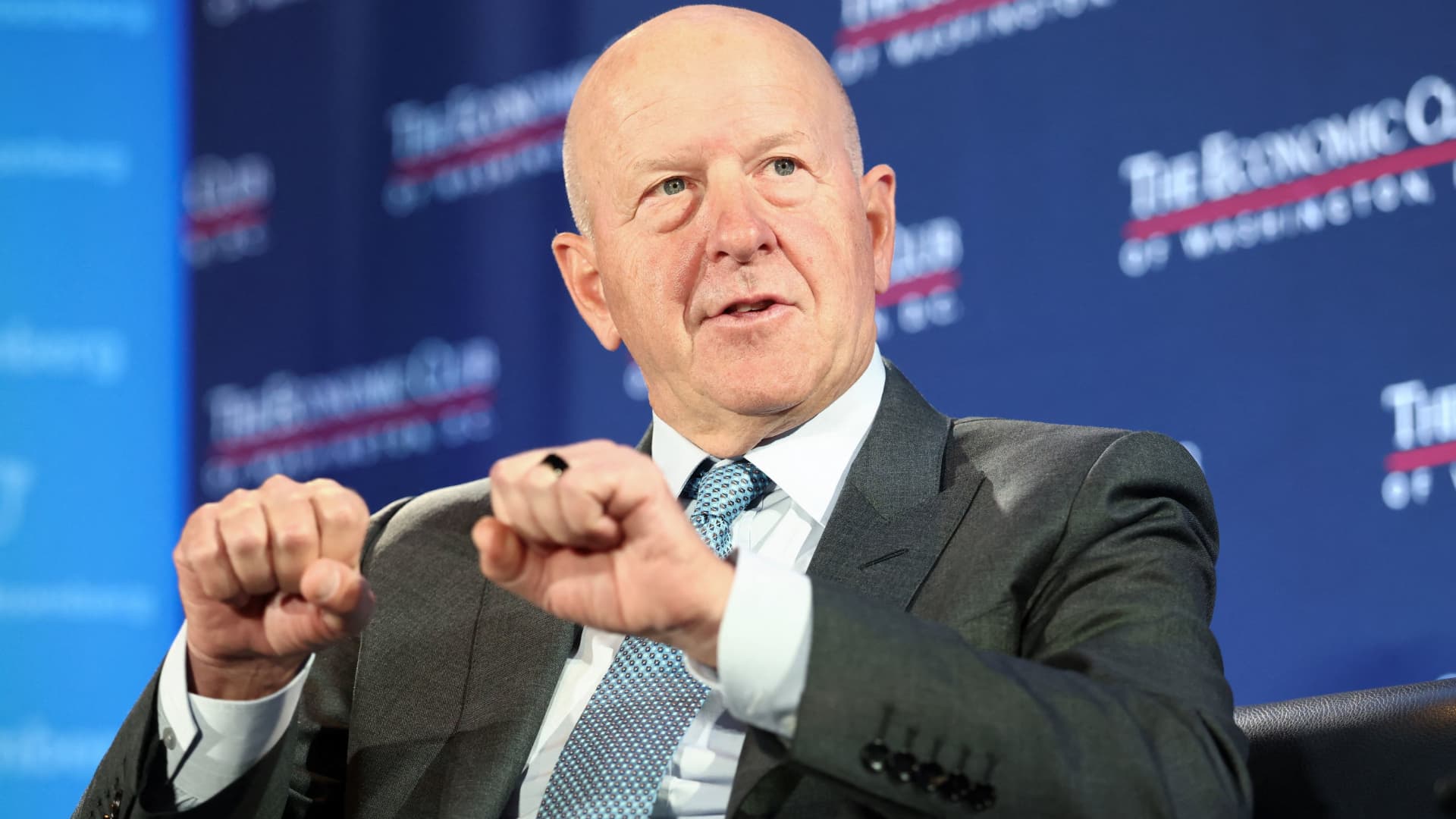
Goldman CEO David Solomon referenced rising volatility “amid the broader uncertainty” of the period.
“Goldman Sachs delivered very strong performance for our shareholders this quarter, even as market conditions became more volatile,” Solomon said in the earnings release. “The geopolitical landscape remains very complex – so disciplined risk management must remain core to how we operate.”
Later Monday, Solomon told analysts on a conference call that while the environment for mergers and other deals has been resilient, he was closely monitoring how the war in the Middle East was developing.
“if the resolution of the conflict drags, that probably will be a headwind in some of these areas, particularly inflation trends as we get further into the second and the third quarter,” Solomon said. “So we’ll have to watch that.”
Solomon also said that market churn from the war cooled IPO listings in March, but that he still saw the need for several large IPOs in the pipeline to come to market.
JPMorgan Chase on Tuesday posted first-quarter results that topped expectations on stronger-than-expected fixed income and investment banking revenue.
Here’s what the company reported:
Earnings: $5.94 per share vs. $5.45 LSEG estimate
Revenue: $50.54 billion vs. $49.17 billion estimate
The company said net income rose 13% to $16.49 billion, or $5.94 a share. Revenue increased 10% to $50.54 billion.
The bank’s fixed income trading revenue rose 21% to $7.08 billion, or about $370 million more than the StreetAccount estimate, on rising activity in commodities, credit, currencies and emerging markets.
Investment banking fees jumped 28% to $2.88 billion, or about $260 million more than expected, on higher mergers advisory and stock underwriting fees.
Another factor helping the bank top expectations in the quarter: it set aside less money for loan losses than analysts had anticipated.
The firm’s provision for credit losses was $2.5 billion, about half a billion dollars less than the StreetAccount estimate, in a sign that JPMorgan’s borrowers remain healthy. Specifically, the firm released reserves for consumers by $139 million in the quarter, though business reserves were boosted by $327 million. A year ago, the firm’s provision was $3.3 billion.
‘Complex set of risks’
Banks have enjoyed tail winds for the past few quarters, from a rebound in investment banking and trading activity to stable consumer credit. Bank’s trading desks, which match buyers and sellers of securities and provide them with financing to make trades, have feasted off of the volatility of the period, while more corporate clients are planning mergers to boost their prospects.
JPMorgan, the biggest U.S. bank by assets and the world’s largest by market cap, has held up on both the Wall Street and the Main Street side of its businesses, leading its CFO to declare last year that it was “firing on all cylinders.”
This year, though, markets have been roiled by concerns over disruption from the latest artificial intelligence models, the risks posed by private credit and the Iran war that began in late February.
JPMorgan CEO Jamie Dimon said in a statement Tuesday that the U.S. economy was resilient in the first period, thanks to consumers and businesses spending and repaying debts, but he noted that uncertainties were mounting.
“There is an increasingly complex set of risks— such as geopolitical tensions and wars, energy price volatility, trade uncertainty, large global fiscal deficits and elevated asset prices,” Dimon said.
“While we cannot predict how these risks and uncertainties will ultimately play out, they are significant and they reinforce why we prepare the firm for a wide range of environments,” he said.
Of note, the bank lowered its guidance for full-year 2026 net interest income, a key driver of bank earnings, from the previous $104.5 billion to about $103 billion.
Goldman Sachs, a rival to JPMorgan when it comes to trading and investment banking, on Monday posted first-quarter results that topped expectations on record equities trading revenue.
Citigroup and Wells Fargo are out with their results Tuesday, while Bank of America and Morgan Stanley will report on Wednesday.
Jane Fraser, CEO of CitiGroup, speaking at the World Economic Forum in Davos, Switzerland on Jan. 20th, 2026.
Oscar Molina | CNBC
Citigroup beat on the top and bottom lines during the first quarter.
Here’s what the firm reported on Tuesday, compared with Wall Street estimates compiled by LSEG:
Earnings per share: $3.06 vs. $2.65 estimate
Revenue: $24.63 billion vs. $23.55 billion estimate
Those results marked the firm’s best quarterly revenue in a decade and a 56% year-over-year jump in earnings per share.
Citigroup posted net income of $5.8 billion, or $3.06 per share, compared with $4.1 billion, or $1.96 per share, a year earlier. Revenue rose 14% to $24.63 billion.
Citigroup’s return on tangible common equity, a measure of profitability, came in at 13.1%, the highest since 2021 and above the firm’s goal of between 10% and 11% ROTCE.
CEO Jane Fraser said in a statement the bank is on track to deliver that ROTCE target this year and said of the firm’s recent streamlining, “We’ve entered into the final phase of our divestitures and 90% of our transformation programs are now at or near our target state.”
Citigroup, whose stock is the best performer year to date among the large banks, has gotten a boost from its turnaround effort and relatively low valuations. The firm has been streamlining its operations and working through several regulatory consent orders, which it reportedly expects to complete this year.
However, with its global footprint, Citigroup is also perceived to be more impacted by the geopolitical environment than many of its peers.
The bank’s markets division was a big driver of its first-quarter beat, with its larger, fixed income division gaining 13% to $5.2 billion in revenue, topping the StreetAccount estimate of $4.68 billion. Equities jumped 39% to $2.1 billion, beating the estimate by about $500 million.
Investment banking came in light compared with estimates, except for equity underwriting, which was $208 million and beat estimates of $186.3 million, according to StreetAccount. The unit comprising services showed revenue that increased by 17% in the quarter to $6.1 billion and surpassed Wall Street expectations of $5.8 billion.
Citi’s wealth and U.S. consumer cards divisions were slightly reconfigured in the quarter and not comparable to estimates. However, they each saw gains thanks to Citigold and retail banking.
The firm’s provision for credit losses was higher than expected — at $2.81 billion versus $2.64 billion expected, per StreetAccount — due to net credit losses in consumer cards and an allowance for credit loss build of $579 million.
Expenses were higher by 7% due to severance and foreign exchange translation.
— CNBC’s Laya Neelakandan contributed to this report.