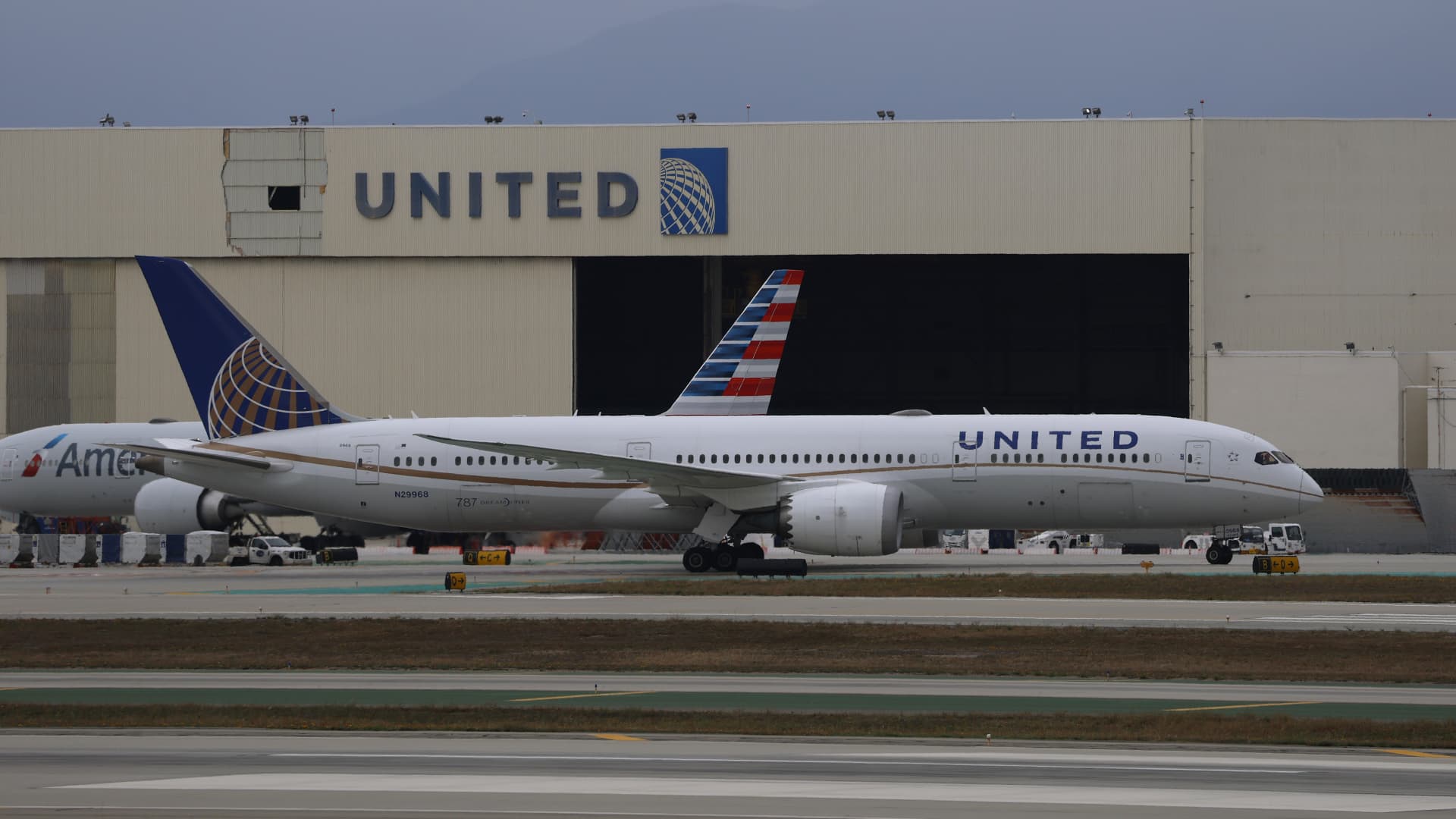
A United Airlines plane taxis at Los Angeles International Airport on April 21, 2026 in Los Angeles, California.
Justin Sullivan | Getty Images
Jet fuel prices have surged this year since the attacks on Iran that began two months ago led to the Strait of Hormuz effectively closing. For now, airline executives say travelers are still flying, increasingly covering the bill.
The price spike hit just ahead of spring break and is eating into airline profits this year. But the booking trends show resilient consumers are prioritizing travel, and executives have a bright outlook for the peak summer demand months, which now trail off in August. There are still questions about how demand will hold toward the end of the year since travelers don’t tend to book that far in advance.
In March, travel-agency ticket sales rose 12% from a year ago to $10.4 billion, with the number of domestic trips up 5% and international up 1%, according to the Airlines Reporting Corp.
Domestic economy ticket prices are up 21% from a year earlier to an average of $570, while premium-seat prices rose 17% to an average $1,444 per trip, ARC data released April 16 shows.
Despite higher fares, “bookings have remained resilient amidst these changes, which is an encouraging sign,” JetBlue Airways CEO Joanna Geraghty said Tuesday on an earnings call.
Airlines’ expectations
U.S. airlines have reported that the Iran war is adding more than $6 billion and counting to their costs this year.
But JetBlue and major carriers this month told Wall Street that they expect customers to cover the higher jet fuel costs by early 2027, if not the end of this year. Carriers have trimmed capacity to cut costs, which also can boost airfare.
JetBlue on Tuesday forecast second-quarter revenue would increase as much as 11% from a year earlier even as Geraghty called the war’s impact the industry’s biggest headwind since the Covid pandemic.
American Airlines on Thursday said it expects an increase of 13.5% to 16.5% in revenue for the second quarter.
“We’ve always been really sharp in terms of managing our load factors, and we see our loads keeping pace with the capacity adds,” American CEO Robert Isom said on an earnings call. “That would suggest that we’re seeing the real benefit in yields right now.”
Delta Air Lines and United Airlines, which make up the majority of the U.S. industry’s profits, were also upbeat about fare growth, especially as airlines depend more on growth from seats like first class or premium economy that can cost thousands of dollars more than economy-class options.
Low-cost, domestic-focused airlines, which tend to have fewer premium options, have struggled. Budget carriers represented by the Association of Value Airlines, including Frontier Airlines and Avelo Airlines are seeking $2.5 billion in relief from the Trump administration to help cover the jump in fuel prices, the group said Monday.
Frontieris set to brief Wall Street analysts next week about its outlook for the year and will likely face questions about its ability to recapture costs with lower average fares than large rivals.
Even if oil prices come down, it’s not likely to mean immediate relief for jet fuel prices, since that product includes refining and transportation costs that take longer to show up.
“It’s possible especially given air ticket prices have grown well below general inflation since COVID” that fares stay high, wrote UBS airline analyst Atul Maheswari on Monday. “As such, we think there is room for airfares to go up and stay higher. This could drive significant earnings growth and margin expansion for airlines in 2027 should jet fuel prices moderate. That said, we think demand would need to hold steady for airlines to maintain pricing next year.”
Starbucks on Tuesday raised its full-year outlook for comparable earnings and same-store sales growth after reporting its second straight quarter of traffic growth.
“This quarter marked a milestone for Starbucks – and the turn in our turnaround,” CEO Brian Niccol said in a video posted alongside the company’s fiscal second-quarter results.
For fiscal 2026, Starbucks said global and U.S. same-store sales are now expected to increase by at least 5%, up from its prior projection of an increase of 3%. Starbucks also raised its forecast for adjusted earnings per share to a range of $2.25 to $2.45 from its previous range of $2.15 to $2.40 per share.
Alarmed by the current war between U.S. and Iran and its effects on fuel, few companies have chosen to hike their outlook for the full year when reporting their quarterly results in recent weeks, making Starbucks an outlier.
Niccol said that higher gas prices haven’t changed the behavior of Starbucks customers yet, although he acknowledged even the company’s higher forecast raise is cautious — relative to its outperformance this quarter.
Shares of Starbucks rose about 5% in extended trading.
Here’s what the company reported for the period ended March 29 compared with what Wall Street was expecting, based on a survey of analysts by LSEG:
Earnings per share: 50 cents adjusted vs. 43 cents expected
Revenue: $9.53 billion vs. $9.16 billion expected
Starbucks reported fiscal second-quarter net income attributable to the company of $510.9 million, or 45 cents per share, up from $384.2 million, or 34 cents per share, a year earlier.
Excluding restructuring and impairment costs as well as other items, the company earned 50 cents per share, beating Wall Street expectations.
The company said net sales rose roughly 9% to $9.53 billion.
Starbucks’ global same-store sales, which only includes cafes open at least a year, increased 6.2%, fueled by more visits to its locations. Wall Street was projecting same-store sales growth of 4%, according to StreetAccount estimates.
The company has continued to see similar same-store sales growth into April, Niccol said on the company’s earnings conference call.
North America, the company’s home market, drove most of the quarter’s same-store sales growth. U.S. same-store sales climbed 7.1%, driven by a 4.3% jump in transactions.
It marks the second straight quarter of traffic growth for Starbucks’ U.S. cafes, signaling that the company’s turnaround has taken hold.
Under Niccol, the chain has cut back on discounts and focused instead on luring customers back by improving cafe operations, adding buzzy new menu items and reintroducing seating to its locations.
“We haven’t seen this transaction strength in years,” Niccol said during the company’s earnings call.
Starbucks’ U.S. sales growth came from across its menu, from its new artisanal bakery items to the increasing popularity of protein cold foam, CFO Cathy Smith said.
Outside the U.S., growth was more tepid. International same-store sales rose 2.6%.
China, the company’s second-largest market, weighed on its results, with same-store sales growth of just 0.5%. Starbucks has been leaning on more discounts in China to drive more visits, resulting in 2.1% higher traffic but a 1.6% decline in average spend.
Boyu Capital closed its deal for a majority stake of Starbucks’ China business at the beginning of the fiscal third quarter, Smith said on the call. The alternative asset management firm now holds a 60% interest in a joint venture with Starbucks in the region.
Going forward, Starbucks does not plan to share China’s standalone revenue and same-store sales since it is now considered part of the company’s licensed portfolio, it said.
New York City’s first full-scale casino with live table games opened to gamblers Tuesday, more than a decade after voters approved an expansion of gambling in the state.
Resorts World, owned by Malaysia-based company Genting, beat out gaming giants such as Wynn Resorts, Las Vegas Sands, Caesars Entertainment and MGM Resorts to land one of three new casino licenses.
It’s the first to launch because it was already operating a slots and electronic gambling facility, one of the most profitable in the world. Resorts World New York City is adjacent to the Aqueduct Racetrack and just a few miles away from John F. Kennedy International Airport.
“We got the license Dec. 15, and here we are, April 28 welcoming our guests to the new casino floor,” Robert DeSalvio, president of Genting Americas East, said in an interview.
Lim Kok Thay, executive chairman of Genting Bhd, center, takes a ceremonial first dice roll alongside rapper Nasir “Nas” bin Olu Dara Jones, center right, and Donovan Richards Jr., Queens borough president, third right, at Resorts World New York City (RWNYC) casino in the Queens borough of New York, US, on Tuesday, April 28, 2026.
Adam Gray | Bloomberg | Getty Images
To run roulette, craps, baccarat and blackjack, Resorts World recruited some dealers from casinos in other states. But it also is running a kind of dealer college, training locals to handle the table action.
The company says the current expansion has already created more than 1,200 new jobs, with another 500 new hires anticipated by this summer.
Though it’s not yet open, the company is also building a sportsbook, which will be the city’s first.
“We have hit the jackpot, Queens!” pronounced Borough President Donovan Richards at the ceremonial opening.
“I have always dreamt of Queens being an international entertainment hub, and this certainly is part of that puzzle,” Richards said.
Queens-raised hip-hop star Nas is a partner in the project and performed at the opening.
“This is just the beginning. So this is about to expand and do things that everyone’s going to be excited about. So Queens is where it’s at,” he told CNBC.
The project has faced criticism, as some locals are concerned about a potential rise in crime and traffic as a result of the development.
For now, the casino will have a city monopoly, for which it says it’s paying 63% state taxes on slots revenue and 30% on table game revenue. In its bid for a license, the company included a clause that stipulates its tax rate will lower to the levels its competitors pay once they’re up and running.
It will take years for the other casinos to open. Bally’s is building a casino on a Bronx golf course purchased from The Trump Organization. Meanwhile, Hard Rock has planned a massive development in partnership with hedge fund manager and Mets owner Steve Cohen near Citi Field, where the baseball team plays.
The three companies were selected by the state’s gambling commission in 2025 following a years-long process to award licenses to New York’s downstate region following an approved 2013 referendum.
The state says the three casinos could produce $7 billion in gaming tax revenue over a decade and CBRE projects annual gaming revenues at maturity of up to $5.6 billion under a bull case scenario.
“We are changing the landscape of New York forever with a building that will never close,” said Kevin Jones, chief strategy officer of Resorts World New York.
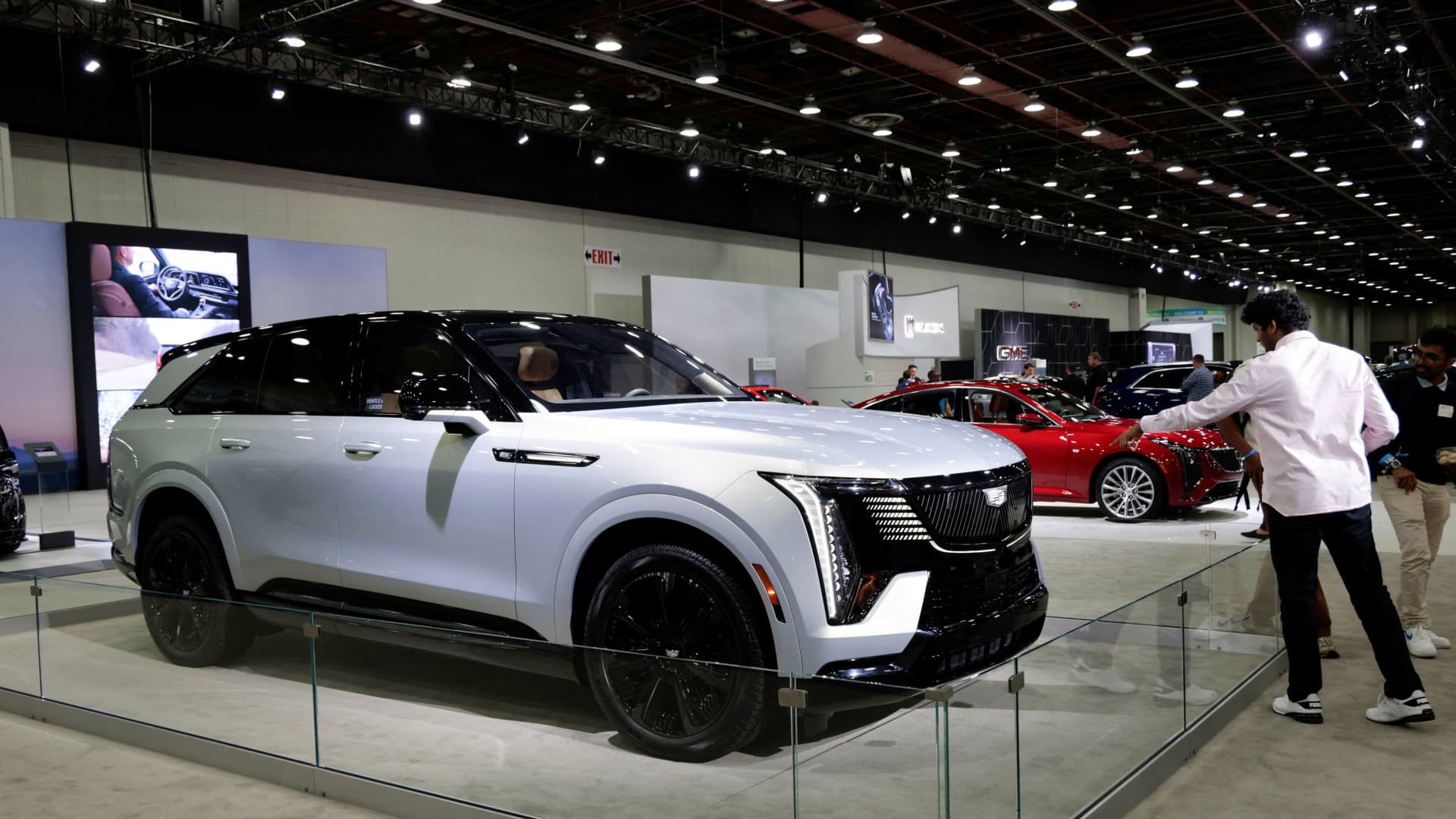
A Cadillac all-electric 2025 Escalade IQ luxury SUV is displayed during press day of the North American International Auto Show in Detroit, Michigan, September 14, 2023.
Rebecca Cook | Reuters
DETROIT — General Motors on Tuesday said the Iran war is causing cost increases to its business, but inflated consumer expenses such as higher gas prices haven’t deterred buyers from spending on pricey vehicles.
GM CEO Mary Barra said the Detroit automaker continues to monitor any change in customer spending but, so far, the company’s vehicle mix has remained healthy.
GM said it had an $52,000 average transaction price for vehicles during the first quarter, which was in line with last year. The average new vehicle transaction price across the industry for March, the most recent data available, was $49,275, according to Cox Automotive.
“I think the biggest variable that we’re looking at is how long does the conflict last and what does it cause from a cost perspective across logistics, supply chain, and if it ends up having any impact on a shift in mix, but, to date, we really haven’t seen that,” Barra said during the company’s first-quarter earnings call Tuesday with investors.
Barra’s comments follow consumer confidence plunging to a record low in April as fears mounted over rising energy prices and the broader impact of the Iran war, according to a University of Michigan survey earlier this month.
They also come after the company reported a 9.7% decline in first-quarter sales compared with an unseasonably high March 2025. GM also said it’s dealing with tighter inventories, specifically on its full-size pickup trucks, as the company retooled for updates to the vehicles for later this year.
Barra said if there are major shifts, including a more apparent move into less expensive or all-electric vehicles, that the company feels it’s well positioned to meet those needs as well.
GM CFO Paul Jacobson and Barra said the Detroit automaker is continuing to offset higher costs as best as it can through warranty improvements, cost efficiencies and potentially by deferring some hiring.
“While our operating performance remains strong, as reflected in our excellent first-quarter results, the war in Iran has raised our costs and its duration remains uncertain,” Barra said. “We are working to offset these cost pressures by reducing spending in other areas and by continuing to find efficiencies across the business.”
The GM executives specifically singled out rising energy and logistics costs due to the Iran war and its impact on oil as driving up costs, but they declined to disclose an exact amount of the impact.
On a broader basis, GM on Tuesday said its first-quarter performance is expected to offset incremental increases in commodity and freight costs — including from logistics and higher DRAM chips — of $1.5 billion to $2 billion for the year.
Dynamic random access memory, or DRAM, chips are semiconductors that are essential for powering infotainment, digital clusters, advanced driver assistance systems and EV systems in vehicles.
But the DRAM costs aren’t related to the Iran war. Those price hikes are coming from increasing demand for the chips, including outside the automotive industry, according to industry experts at S&P Global Mobility.
“Automotive is not the only industry vying for DRAM. The current supply crunch is driven by the AI explosion, especially in data centers, where high-bandwidth memory (HBM) DRAM is in high demand. As a result, major DRAM manufacturers are reallocating wafer capacity to serve this more lucrative market,” according to a Feb. 26 post from S&P Global Mobility.
Jacobson on Tuesday said the company has “no real concerns” about supply chain shortages involving the Iran war, specifically concerning raw materials, at the moment.
“We’re not projecting or worried about any shortages right now, and I think the supply chain team has continued to prove their resolve through yet another challenge, as we’ve seen them do in years past,” he said.
GM on Tuesday said it has, and will continue to, divert shipments of vehicles, including its highly profitable full-size pickups and SUVs, to the U.S. instead of the Middle East amid the war.
“Usually that’s a very strong market. So after this conflict ends, I think there’s upside there,” Barra said.
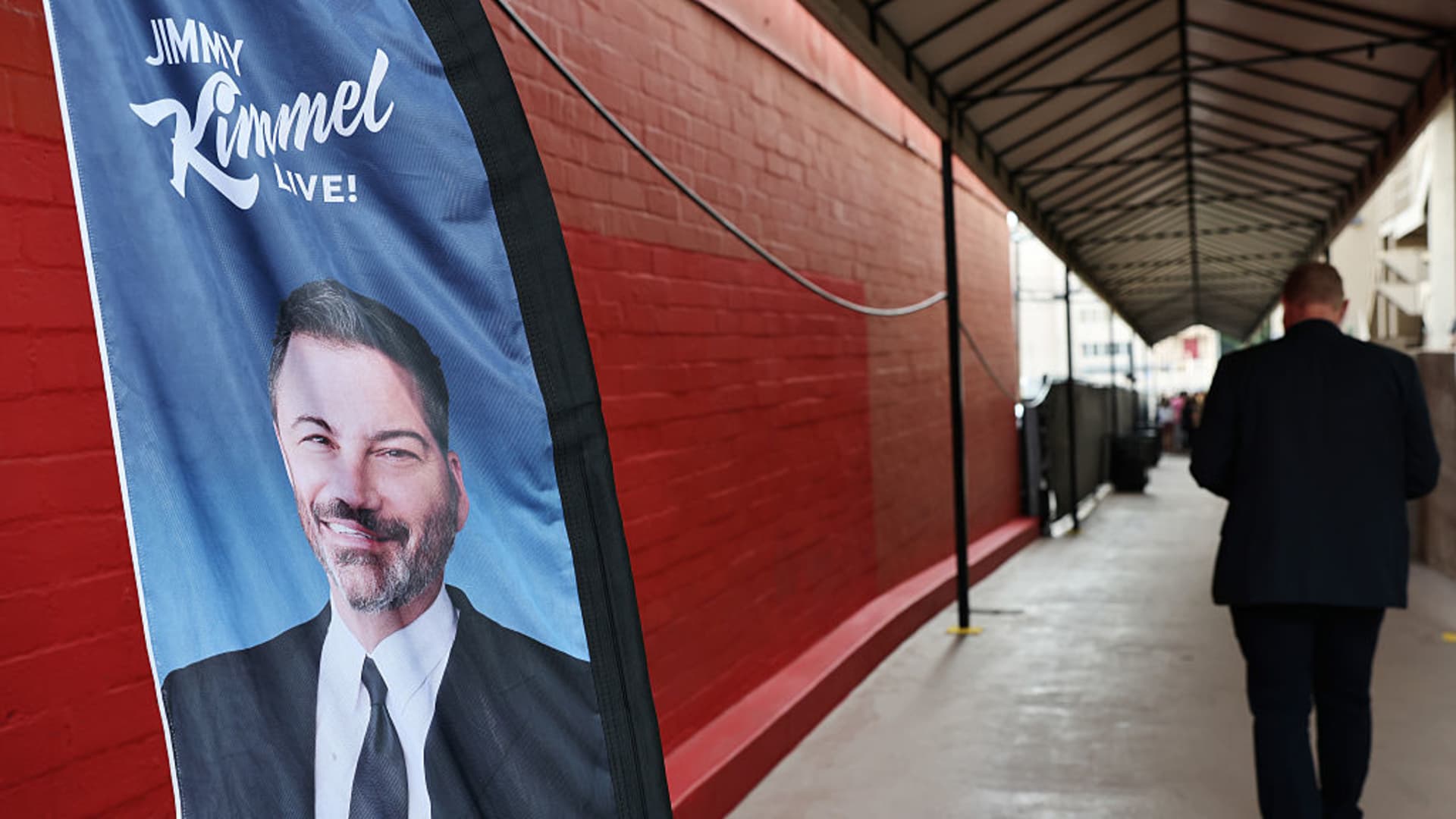
A sign is displayed outside the El Capitan Entertainment Centre in Hollywood where the “Jimmy Kimmel Live!” show will be recorded on the first night the show will return to the ABC lineup on September 23, 2025 in Los Angeles, California.
Mario Tama | Getty Images
President Donald Trump is reviving calls this week for Disney-owned ABC to pull comedian Jimmy Kimmel off the air in yet another test for late night TV during the Republican president’s second term.
While it’s not the first time Kimmel has faced backlash over a show monologue — his show was briefly suspended in September after broadcast station owners threatened to disrupt the program following comments about the killing of conservative activist Charlie Kirk — the renewed challenges now fall under freshly installed Disney CEO Josh D’Amaro, who took the helm last month.
Trump and First Lady Melania Trump called on ABC to fire the late night host after he referred to the First Lady as an “expectant widow” during a comedy sketch last week, days before an alleged assassination attempt at the White House Correspondents’ Dinner.
Melania Trump said in a post on X that Kimmel’s comments were “hateful and violent rhetoric” and “intended to divide our country.” Shortly after, Trump posted on his Truth Social platform that Kimmel’s comments amounted to a “call to violence” and were “far beyond the pale.”
In a subsequent monologue on Monday night, Kimmel addressed the backlash, saying the remark was “a joke about their age difference.” He added that it was “not, by any stretch of the definition, a call to assassination. And they know that.”
White House Director of Communications Steven Cheung said in a post on X Tuesday that Kimmel should be “shunned” for “doubling down on that joke instead of doing the decent thing by apologizing.”
Representatives for Disney didn’t immediately respond to request for comment.
Mounting political pressure
The incident is the latest in a string of battles between Trump and legacy media — and late night TV in particular — that has left the industry on precarious footing.
Back in September, broadcast station owners Nexstar and Sinclair said they would preempt Kimmel’s show, airing other content instead during his time slot, after Federal Communications Commission Chairman Brendan Carr raised issue with Kimmel’s comments about Kirk.
Representatives for Nexstar and Sinclair declined to comment on the latest Kimmel comments.
Carr in September suggested broadcast station licenses were at risk of being revoked, spurring debate about First Amendment protections and the responsibility of national broadcasters like ABC to air generally acceptable content.
Disney returned Kimmel’s late night show to air a few days after the suspension, and Kimmel apologized for the comments in his first show back.
But the back and forth could serve as something of a precedent if the Trump administration keeps putting pressure on media firms.
On Tuesday, Semafor reported that the FCC was preparing a review of Disney’s broadcast licenses, but cited a source in saying the timing wasn’t related to Kimmel’s monologue. Representatives for the FCC and Disney didn’t immediately respond to requests for comment on that report.
Last year, Paramount-owned CBS announced it would bring an end to “The Late Show with Stephen Colbert” while the company awaited FCC approval for its merger with Skydance. The merger got the green light from regulators shortly after the announcement.
While Disney has said that it doesn’t have plans for mergers or acquisitions in the near term, it has had a few run ins with the Trump administration.
In December 2024, ABC News agreed to pay $15 million toward Trump’s future presidential library in order to settle a defamation lawsuit brought by the President against the network and anchor George Stephanopoulos.
Last year, ABC News also cut ties with national correspondent Terry Moran after he said Trump and senior White House advisor Stephen Miller were “world-class” haters in a social media post.
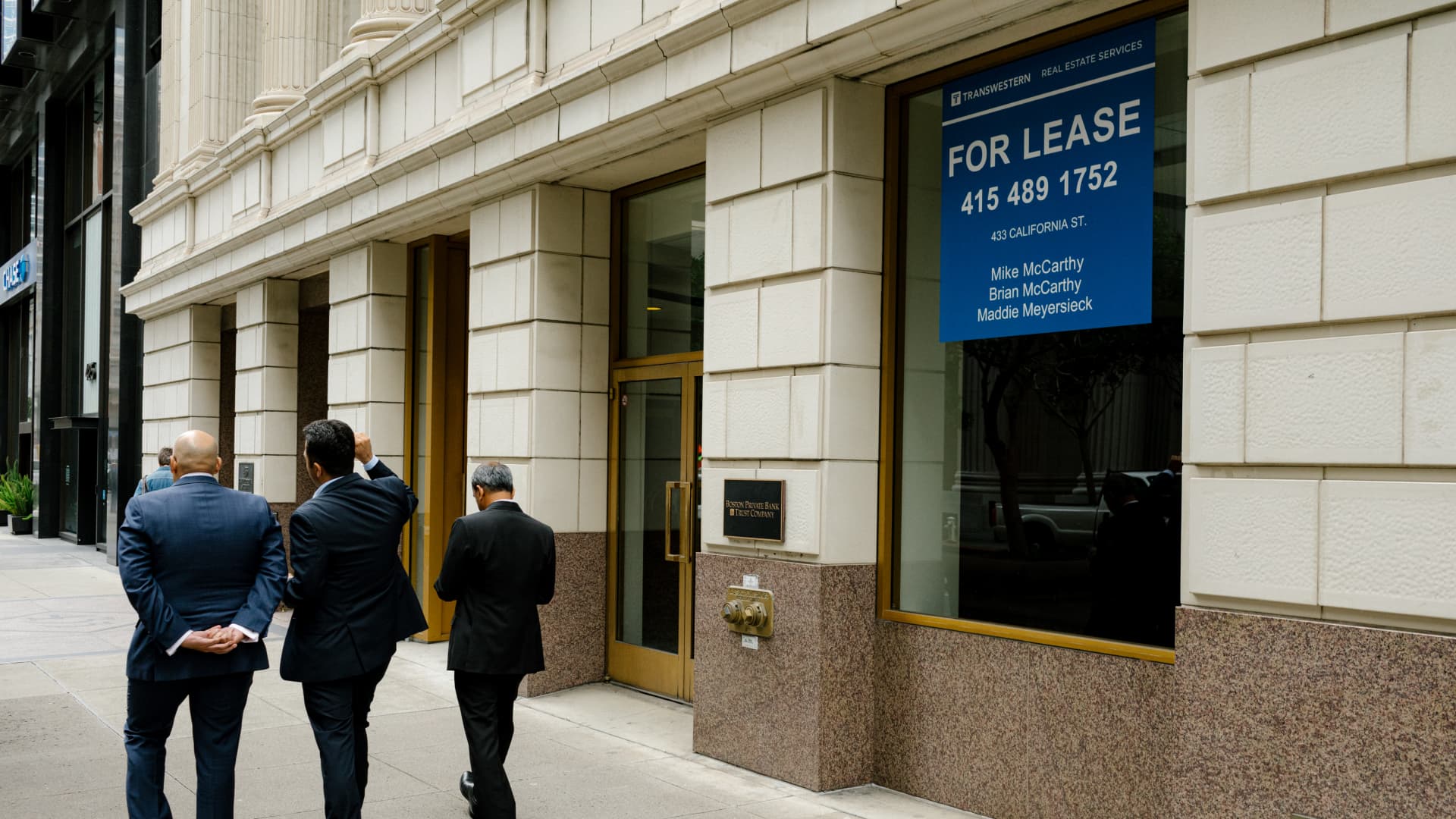
A “For Lease” sign in the Financial District of San Francisco, California, US, on Wednesday, May 3, 2023.
Jason Henry | Bloomberg | Getty Images
A version of this article first appeared in the CNBC Property Play newsletter with Diana Olick. Property Play covers new and evolving opportunities for the real estate investor, from individuals to venture capitalists, private equity funds, family offices, institutional investors and large public companies. Sign up to receive future editions, straight to your inbox.
Despite the war with Iran and continued economic uncertainty in the U.S., demand for office space is recovering at a strong clip.
In the first quarter of this year, new in-person and virtual office tours reached their highest level since the pandemic began, as measured by the VTS Office Demand Index. The index is a future indicator of lease signings about a year or more out.
The index rose 18% from the fourth quarter 2025 and 13% from the same quarter one year ago.
“Although tested against a turbulent backdrop, demand for office space has seen an exceptional start to the year,” Nick Romito, CEO of commercial real estate software company VTS, said in a release. “What perhaps is most notable about this quarter’s positive performance is that it was led not just by tech’s sustained AI boom – but also by finance and legal companies entering the market as well.”
The surge in demand is curious, given that office-using employment is still down 2% from 2022, according to the Bureau of Labor Statistics. Usually, that would result in less office demand, but the drop in employment could also be giving employers more leverage to get workers back into the office.
Nationally, for all buildings, the office vacancy rate fell 14 basis points to 22.2% in the first quarter of this year from the previous quarter and is down 30 basis points from the last peak in Q2 2025, according to a report from JLL, a commercial real estate services and investment management company. Vacancy remains hyper-concentrated predominantly in larger-scale, aging buildings with financially constrained owners, with 10% of office buildings comprising more than 60% of total national vacancy.
As with everything in real estate, the office recovery is local. San Francisco and New York City are leading office demand, as AI tech employment rises quickly in the former and diversity of employment fuels the latter. Los Angeles also saw double-digit increases in demand on a quarterly basis, fueled by significant growth in the creative industry, according to VTS.
Cities seeing weaker demand include Boston, which was the worst-performing market in the report. Life science offices have taken a hit in that city, due to significant government funding cuts.
In addition, demand is contracting in Seattle, Washington, D.C., and Chicago, as they are not seeing strong employment growth.
“The AI boom continues to be a dominant headline for office, and markets that lack a major tech presence, or are without a primary growth lever in another industry, are seeing declines in demand,” Ryan Masiello, chief strategy officer of VTS, said in a release. “LA’s positive performance this time around was a new bright spot – and it remains to be seen if Los Angeles can sustain growth in the near term.”
Get Property Play directly to your inbox
CNBC’s Property Play with Diana Olick covers new and evolving opportunities for the real estate investor, delivered weekly to your inbox.
A UPS driver sits in his truck on April 15, 2026 in the Flatbush neighborhood of the Brooklyn borough in New York City.
Michael M. Santiago | Getty Images
United Parcel Service on Tuesday posted first-quarter earnings results that beat on the top and bottom lines.
Shares of the delivery giant sank roughly 3% in premarket trading.
Here’s how the company performed in its first quarter, compared with what Wall Street was expecting, based on a survey of analysts by LSEG:
Earnings per share: $1.07 adjusted vs. $1.02 expected
Revenue: $21.2 billion vs. $20.99 billion expected
For the quarter ended March 31, UPS reported net income of $864 million, or $1.02 per share, compared with $1.19 billion, or $1.40 per share, a year prior. Adjusting for one-time items, the company reported a profit of $906 million, or $1.07 per share.
“The first quarter of 2026 marked a critical transition period for UPS in which we needed to flawlessly execute several major strategic actions and we delivered,” CEO Carol Tomé said in a statement. “With that behind us, we expect to return to consolidated revenue and operating profit growth, and adjusted operating margin expansion in the second quarter of this year.”
For its full-year 2026 outlook, the company reaffirmed its consolidated financial estimate of $89.7 billion in revenue and non-GAAP adjusted operating margin of 9.6%.
In its domestic segment, UPS said revenue declined 2.3%, primarily due to an expected decline in volume.
UPS is also in the midst of a turnaround plan and enhancing the automation in its network. In the first three months of the year, UPS said it achieved $600 million in cost savings from its network efficiency program, with expectations to reach $3 billion in year-over-year savings in 2026.
Company executives will hold a conference call at 8:30 a.m. ET.
The General Motors global headquarters at Hudson’s Detroit in Detroit, Michigan, US, on Monday, Jan. 12, 2026.
Jeff Kowalsky | Bloomberg | Getty Images
DETROIT – General Motors is set to report its first-quarter earnings before the bell Tuesday.
Here’s what Wall Street is expecting, based on a survey of analysts by LSEG:
Earnings per share: $2.62 adjusted
Revenue: $43.68 billion
Those results would mark a roughly 1% decline in revenue compared with a year earlier and a 5.8% decrease in adjusted earnings per share.
GM’s 2025 first-quarter results included $44.02 billion in revenue, net income attributable to stockholders of $2.78 billion, and adjusted earnings before interest and taxes of $3.49 billion.
Aside from earnings and any changes to the automaker’s 2026 guidance, investors will be monitoring effects from the Iran war, tariff impacts and additional charges related to the automaker’s pullback in all-electric vehicles.
After announcing $7.6 billion in EV write-downs last year, the automaker said it expected additional charges but at a lower level than in 2025.
GM’s 2026 earnings guidance is better than its expectations and results from last year. It includes net income attributable to stockholders of between $10.3 billion and $11.7 billion; adjusted earnings before interest and taxes of $13 billion to $15 billion; and EPS of between $11 and $13 for the year.
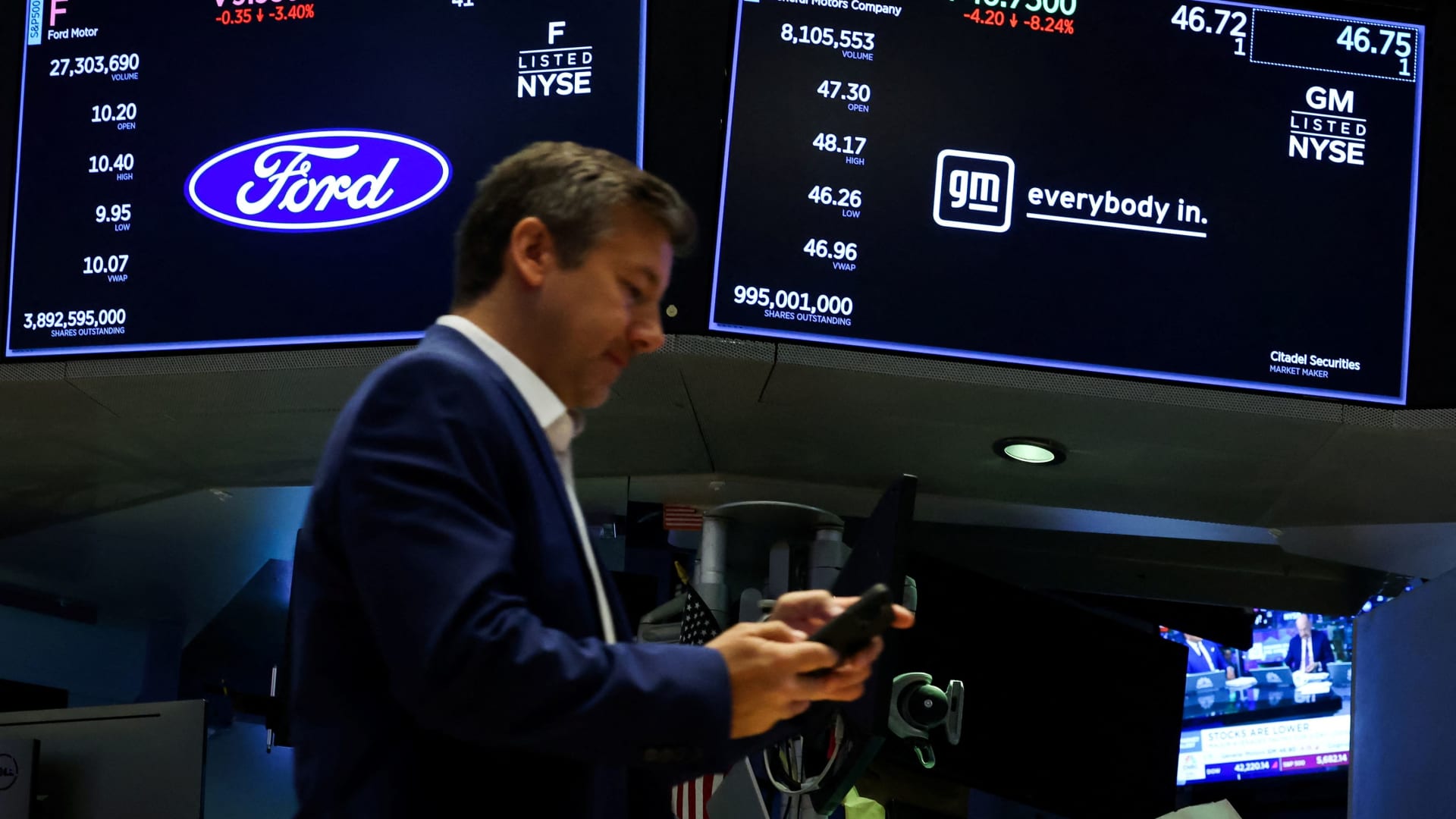
Traders work on the floor at the New York Stock Exchange in New York City, March 27, 2025.
Brendan McDermid | Reuters
DETROIT — As America’s largest automakers prepare to report first-quarter earnings results this week amid rising oil and commodity costs due to the Iran war, they find themselves traversing different terrains.
General Motors is on the smoothest track, and Wall Street analysts are expecting it to continue on its current path. Ford Motor is on a bumpy road as it detours from CEO Jim Farley’s turnaround plan. And Stellantis is off-roading, going through some tough terrain, but it has its Jeep and Hemi V8-powered Ram brands to keep it moving.
Their individual circumstances are being exacerbated by current market conditions, as the auto industry faces massive losses from all-electric vehicles, slowing consumer demand for new vehicles, and rising prices from supply chain issues and the Iran war.
Wall Street’s first-quarter expectations are a testament to their current terrains: GM is anticipated to outperform its crosstown rivals with adjusted earnings per share, or EPS, of $2.61 during the first three months of the year, followed by 19 cents for Ford, according to average estimates compiled by LSEG. Estimates from LSEG for Stellantis did not meet CNBC standards for comparison for the quarter, but the average forecast for the year is 73 euro cents (85 U.S. cents).
“GM has a strong multiyear track record of the three things I think are asked of any successful auto company: steady, slightly growing market share; solid margins … and that solid margin performance translating to strong free cash flow, which ultimately funds a strong shareholder return,” said James Picariello, BNP Paribas Equity Research senior analyst and head of U.S. auto research. “GM really has, and continues to, check all those boxes.”
GM, Ford and Stellantis stocks in 2026.
GM is rated overweight with a $94.71 target price, according to average ratings compiled from analysts by financial data provider FactSet. That compares with Ford and Stellantis at hold ratings with $13.67 and $9.09 price targets, respectively.
While many analysts have said they’re optimistic about upsides for the “Detroit Three” companies, including potential rebates from tariffs and pricing resiliency, others are more bearish, largely due to the Iran war driving up raw material, freight and energy costs.
“[Automakers] ultimately pay the bills, and therefore we see downside risk to guides,” Wells Fargo analyst Colin Langan said in a March 31 investor note. “We forecast all the D3 miss Q1 consensus EBIT,” Langan said, referring to earnings before interest and taxes.
GM is set to report its first-quarter results Tuesday, followed by Ford on Wednesday and Stellantis on Thursday.
GM
While the country’s largest automaker has been steady, investors continue to watch its move away from EVs, tariff impacts and pending updates to its crucial full-size pickups.
Picariello and other analysts expect GM will maintain, if not slightly raise, its 2026 guidance. CFO Paul Jacobson has described 2026 as the “most stable start to a year that we’ve seen in the last five years,” and GM has had a history of conservative forecasting.
General Motors Executive Vice President and Chief Financial Officer Paul Jacobson addresses investors at the GM Tech Center in Warren, Michigan, Oct. 6, 2021.
Courtesy GM
“As a team, what we’ve really done over the last several years, and I think has been a great story of our resilience, is just focus on overcoming obstacles. It’s a team that is focused on achieving our objectives, and we’re doing it with more discipline and really looking forward to more of that in 2026,” Jacobson said in mid-February.
GM’s 2026 earnings guidance is better than its expectations and results from last year. It includes net income attributable to stockholders of between $10.3 billion and $11.7 billion; EBIT of $13 billion to $15 billion; and EPS of between $11 and $13 for the year.
GM’s first quarter could be boosted by potential tariff rebates, resilient pricing, growth in entry-level vehicles and pullback in all-electric vehicles, according to Wall Street analysts.
The automaker, which is still analyzing its electric portfolio, has so far announced $7.6 billion in write-downs related to EVs.
Ford
Ford, meanwhile, hasn’t been quite as steady as its crosstown rival.
The company announced a leadership change and business restructuring last week and is dealing with supply chain disruptions and cost increases for aluminum, a key material for its F-Series pickup trucks.
Ford said it lost 100,000 units of F-Series production last year due to fires at a New York aluminum plant of supplier Novelis. Ford has said the supplier isn’t expected to be operational again until between May and September.
Ford has plans to recapture at least half of those units this year, but that may be harder to do than expected.Based on Ford’s reported production numbers, the company would need to achieve near-record output for the remainder of the year, according to Picariello.
“It’s a level that Ford has only done in a single month in the last two and a half years,” he said. “I’m not raising alarm bells on Ford. I have a neutral rating, but that’s a major, major watch item bucket to this earnings bridge for this year.”
Ford vehicles at a production center in Dearborn, Michigan, on the day of a visit by President Donald Trump, Jan. 13, 2026.
Evelyn Hockstein | Reuters
There are also concerns about aluminum prices, as Ford has sourced that material from other suppliers at a higher cost during the first half of the year. Amid the Iran war, aluminum spot prices also increased by 13% quarter over quarter, Deutsche Bank noted.
“Ford highlighted stability in aluminum supply costs for 2H26 as a positive factor. However, following Ford’s 2026 guidance, the Middle East crisis has significantly impacted aluminum and steel prices,” Deutsche Bank analyst Edison Yu said in an April 17 note to investors.
Ford’s 2026 guidance includes adjusted EBIT of between $8 billion and $10 billion, up from $6.8 billion last year; adjusted free cash flow of between $5 billion and $6 billion, up from $3.5 billion in 2025; and capital expenditures of $9.5 billion to $10.5 billion, up from $8.8 billion.
Stellantis
Stellantis’ global vehicle shipments during the first quarter increased 12% compared with a year earlier, as the automaker executes a sales recovery plan under CEO Antonio Filosa.
Shipments were up in every region, including a 4% increase in the U.S., which has been a focus for the company to regain market share following years of declines under Filosa’s predecessor Carlos Tavares.
Jeep accounted for 47% of the company’s U.S. sales during the first quarter, followed by Ram Trucks at 37%, combining for roughly 84% of Stellantis’ U.S. volumes to begin the year.
Stellantis CEO Antonio Filosa speaks during an event in Turin, Italy, Nov. 25, 2025.
Daniele Mascolo | Reuters
“2026 is our year of execution. What we have committed to deliver is progressive performance improvements on all our business [key performance indicators],” Filosa said during the company’s fourth-quarter results call. “2025 was a year of reset, with results that reflect the considerable cost of needed changes.”
The automaker, which formed in 2021, reported its first-ever annual loss of 22.3 billion euros ($26 billion) in 2025 after booking substantial write-downs amid a major strategic shift away from EVs that included 25.4 billion euros in write-downs.
While investors will be watching Stellantis’ first-quarter results for signs of traction in the company’s turnaround plan, they are anxiously awaiting the company’s capital markets event next month where Filosa has said he will lay out the company’s future plans.
Stellantis’ 2026 forecast includes a mid-single-digit percentage increase in net revenue and a low-single-digit adjusted operating margin.
“The bar is set particularly low in all metrics, and we see opportunities but also risks into 2026 as the sequential product improvement is not translating into clear share gains yet, potentially impacting price, margin and [free cash flow] pressure,” Morgan Stanley analyst Javier Martinez de Olcoz Cerdan said in a Feb. 3 investor note downgrading the stock.
— CNBC’s Michael Bloom contributed to this report.
Spotify is increasing its push beyond music and podcasts as the company on Monday announced a new fitness category partnership with Peloton Interactive.
The deal will make more than 1,400 Peloton classes available to Spotify Premium subscribers across most of its global markets, embedding fitness content directly into Spotify’s existing audio and video ecosystem, according to the companies. The offering includes strength training, Pilates, barre, yoga, meditation and more.
“As we continue to forge a path deeper into wellness, our work with Spotify is just our latest move to expand our reach and capture new revenue streams through Peloton’s unmatched experience, content and instruction,” Peloton’s chief commercial officer, Dion Camp Sanders, said in the release.
Neither company disclosed financial terms, but the partnership is an indication of both companies’ strategic priorities.
For Spotify, the move represents a deeper expansion into wellness, opening up new engagement and monetization pathways beyond its core music and podcast business. Fitness content keeps users on the platform longer and creates opportunities to layer in subscriptions, advertising and creator-driven revenue streams, the company said in a release.
Spotify said more than 150 million fitness playlists are already active globally, with nearly 70% of Premium users reporting they work out monthly.
“Fitness is a natural extension of how people already use Spotify today — to get motivated, recover and reset,” a Spotify spokesperson told CNBC.
Spotify is also building out a broader creator ecosystem around fitness beyond Peloton, working with fitness creators like Yoga With Kassandra, Caitlin K’eli Yoga, Sweaty Studio and Chloe Ting who can monetize through existing tools such as the Spotify partner Program.
For Peloton, the agreement accelerates its pivot away from a hardware-centric model toward scalable, high-margin content distribution. CEO Peter Stern said the deal also builds on his international expansion ambitions.
“Spotify provides a global stage for our instructors, in which they have now the ability to meet hundreds of millions of Spotify Premium subscribers,” Stern told CNBC.
By tapping Spotify’s reach, Peloton is gaining exposure without requiring users to own its equipment or subscribe to its standalone app.