Ben Johns comes over to the right side to hit a dink shot against Anna Bright and Hayden Patriquine in the 2026 PPA Carvana Mesa Cup finals match of the Pro Mixed Doubles Division at Arizona Athletic Grounds on February 22, 2026 in Mesa, Arizona.
Bruce Yeung | Getty Images
Pickleball Inc., the new parent company of Major League Pickleball and the PPA Tour, said Friday it has raised a record $225 million in new investment, as the paddle sport continues its rapid growth trajectory.
The latest investment comes from Apollo Global Management’s newly created sports fund, Apollo Sports Capital, and Dundon Capital Partners, owned by billionaire Tom Dundon. Dundon is an owner of the Portland Trail Blazers NBA team and the Carolina Hurricanes NHL team and was an early investor in pickleball.
The fresh funds bring the total investment in Pickleball Inc. to $315 million, as investors continue to look at emerging sports as a place to park their money. The raise values Pickleball Inc. at $750 million, according to a person familiar with the matter, who asked to remain unnamed because they were not authorized to speak publicly about the company’s valuation.
The deal also includes rolling up several pickleball assets under the Pickleball Inc. umbrella, creating what the company called the largest pickleball ecosystem to date.
Pickleball Inc. will take on a portfolio of pickleball assets previously owned by Dundon, including Pickleball Central, a leading site for pickleball equipment founded in 2006. The portfolio also includes PickleballTournaments.com, software that powers thousands of tournaments across all levels of play, as well as Just Courts, a pickleball court installer.
Pickleball Inc.’s newly merged business verticals combined generated over $140 million in 2025 revenue, the company said.
In a release, MLP and PPA Tour CEO Connor Pardoe called the new investment a “seismic day” for pickleball’s rapidly growing business at all levels.
“This investment allows us to fully integrate the sport into one cohesive ecosystem – uniting professional pickleball, consumer goods, technology, and media under a single, unified platform,” Pardoe said.
Dundon and the Pardoe family will remain majority shareholders in the business after the investment.
Pickleball has exploded in popularity in recent years, with more than 24 million U.S. players participating in 2025, making it the fastest growing sport in the country over the last three years, according to the Sports & Fitness Industry Association’s Annual Report.
At the professional level, the MLP and PPA Tour have seen major growth with a combined $30 million in sponsorship revenue in 2025 and $60 million in combined top line revenue for 2025, according to the United Pickleball Association, which operates both leagues. The MLP and PPA Tour are projecting $74 million in combined revenue in 2026.
The new capital for Pickleball Inc. will be used to further integrate the pickleball business at all levels of play and create a streamlined pickleball ecosystem, the company said.
“This capital raise will allow us to expand our focus into new and scalable opportunities like content, media, and the development of infrastructure to support our fast growing events,” MLP Commissioner Samin Odhwani said in a statement. “The continued and dynamic year-over-year growth data has proven without doubt that pickleball is no longer an emerging sport, and is instead quickly becoming the next tier one sport in America.”
Get the CNBC Sport newsletter directly to your inbox
The CNBC Sport newsletter with Alex Sherman brings you the biggest news and exclusive interviews from the worlds of sports business and media, delivered weekly to your inbox.
Paramount Skydance CEO David Ellison speaks on stage during the Paramount Pictures presentation at CinemaCon at The Colosseum at Caesars Palace in Las Vegas, April 16, 2026.
Valerie Macon | AFP | Getty Images
Paramount CEO David Ellison is trying to do something that no other studio has done in the modern age of cinema — release 30 films annually.
Ellison once again promised this theatrical feat in front of thousands of exhibitors at CinemaCon on April 16. Applause erupted from the crowd after he made the pronouncement.
But privately, movie theater operators have expressed concerns and skepticism about the proposed future slate of films. While a massive string of releases would help cinemas, companies doubt Ellison will be able to follow through on the promise.
His 30-film plan would hinge on Paramount receiving regulatory approval for its proposed merger with Warner Bros. Discovery, which the latter company’s shareholders approved on April 23. Ellison noted that each studio would produce 15 films a year.
However, Ellison has not provided many details about those 30 releases, and it’s not clear how he would hit the ambitious goal. Representatives for Paramount did not reply to CNBC’s request for comment.
It’s unclear if all of the films would have wide releases — meaning they eventually play in at least 1,500 theaters, though the typical benchmark is 2,000. It’s also not certain whether the company will count films it distributes but doesn’t produce as part of this figure, or how many of those proposed titles will be considered tentpole blockbusters.
Movie theater operators and industry experts are skeptical that Paramount would be able to sustain a 30-film slate after the initial merger. After all, part of the consolidation process is eliminating redundancies, which inevitably leads to layoffs as well as cost-cutting measures that often result in fewer productions.
“When it comes to traditional brand-new wide release films, 30 movies a year is a lofty plan given that most distributors are releasing on average anywhere from 10 to 15 wide releases each year,” said Paul Dergarabedian, head of market trends at Comscore.
In the past 25 years, no studio has released 30 films in a single year. The combination of 20th Century Fox and Searchlight came close in 2006 when the studios had 25 wide releases, according to data from Comscore.
The data also shows that when studios have merged in the past, the result has been fewer theatrical releases, not more.
Prior to acquiring 21st Century Fox and its studio assets, Disney was averaging 12 films a year dating back to 2000. Meanwhile, the combined efforts of 20th Century Fox and Searchlight averaged 16 films during that same time. Not including 2020, in which theatrical releases were impacted by pandemic-related cinema closures, Disney has averaged around 13 films a year following the 2019 acquisition.
The line chart shows the annual film releases by Disney and 20th Century between 2000 and 2019 ahead of the two companies’ eventual merger.
“I don’t remember any instance with consolidation where one plus one equals two,” Eric Handler, managing director and senior research analyst at Roth Capital Partners, told CNBC.
Additionally, a combined Paramount and Warner Bros. slate would face some logistical issues in placing 30 films on a 52-week calendar, as well as competition for coveted premium large format theaters.
The wider Hollywood cohort has also balked at the merger, citing similar concerns about job losses and reduced productions. More than 4,000 A-listers, including Robert De Niro, David Fincher, Pedro Pascal and Florence Pugh have signed an open letter opposing the combination of the two companies.
At least one theater operator, however, is supportive of the merger. AMC CEO Adam Aron came out in favor of Paramount’s acquisition of Warner Bros. during CinemaCon earlier this month.
“Of particular importance are David’s public commitments to expand film distribution by Paramount and Warner to at least 30 movies per year, and his vocal embrace of a 45-day exclusive theatrical window,” he wrote in a statement.
“I am confident that David Ellison is sincere as to his intentions, and truly believe that he in fact will wind up delivering on these commitments,” he added.
‘Empty seats and vacant screens’
However, Ellison’s target would not only be higher than any recent precedent — it would be significantly more.
“Historically, the max you’re seeing out of the studio is sort of 20 a year,” said Doug Creutz, senior research analyst at TD Cowen.
He noted that studios like Disney, Universal and Warner Bros. have the funds to make 30 films annually, but they don’t, not only because is it not profitable to do so, but also because few studios have enough quality intellectual property or original stories to put out in a year.
“If you had 30 good ideas, then I’d say do it, but you won’t,” he said. “Most studios don’t have 20 good ideas.”
“I think that the reality of it is that they’ll realize that, they probably realize it already, but they’re saying 30 because you’re trying to get the deal approved,” Creutz added. “I would say my guess is that there isn’t a year where Warner plus Paramount release 30 films unless the slates are already set pre-merger.”
This sentiment was repeated by industry analysts, movie theater owners and even rival studios during private conversations CNBC had at CinemaCon earlier this month. More so, there was an overwhelming sense of tension between studios and cinema operators, particularly when it came to the number of theatrical titles being offered up.
Theater companies would welcome more quality releases, but there has been a shortage of them following the Covid pandemic.
“I tell people that the only thing that exhibition has are empty seats and vacant screens until the studios step up and give us something to play,” one veteran movie theater executive, who requested anonymity to speak candidly, told CNBC. “We have no other alternative.”
The executive noted that re-released films, live sports and concert screenings “don’t pay the bills,” and even concession sales aren’t driving the same kind of revenue that they used to.
“We can’t survive without movies,” the executive said.
Movie theaters have struggled in the wake of the pandemic because of a lack of titles. Production was slowed due to Covid-related shutdowns and was exacerbated when both the writers and actors guilds went on strike just a few years later. At the same time, streaming has become more prominent and studios are producing fewer titles for theatrical release.
Fewer films has led to lower domestic box office hauls. Prior to the pandemic, annual ticket sales routinely topped $11 billion in the U.S. and Canada, but in the years after, the combined efforts of the studios have yet to surpass $10 billion.
This year could break that trend, as the slate of films is significantly larger. However, if a merger does take place, the expectation is that the release schedule will once again shrink.
“We know what’s going to happen,” the veteran theater executive said. “We know that when Paramount eats Warner, it’s going to be exactly like Disney-Fox. There is no difference.”
Other theater operators echoed these sentiments when speaking anonymously to CNBC. They, too, questioned how the gaps in the slate would be filled if Paramount can’t deliver on its 30-film plan.
Amazon MGM has already stepped up to the plate in recent years and has promised at least 15 theatrical releases per year starting in 2027. The studio is on pace to have 13 releases in 2026. One of its recent films, “Project Hail Mary,” which arrived in theaters in March, has set box office records for the studio and delivered audiences to theaters.
However, Amazon’s 15-film annual addition to the overall slate was already replacing the films lost from the Disney-Fox merger. It wouldn’t be enough to also account for any losses in titles from a merger between Paramount and Warner Bros.
“It’s not great for exhibition,” the cinema veteran said. “It’s a lose-lose proposition.”
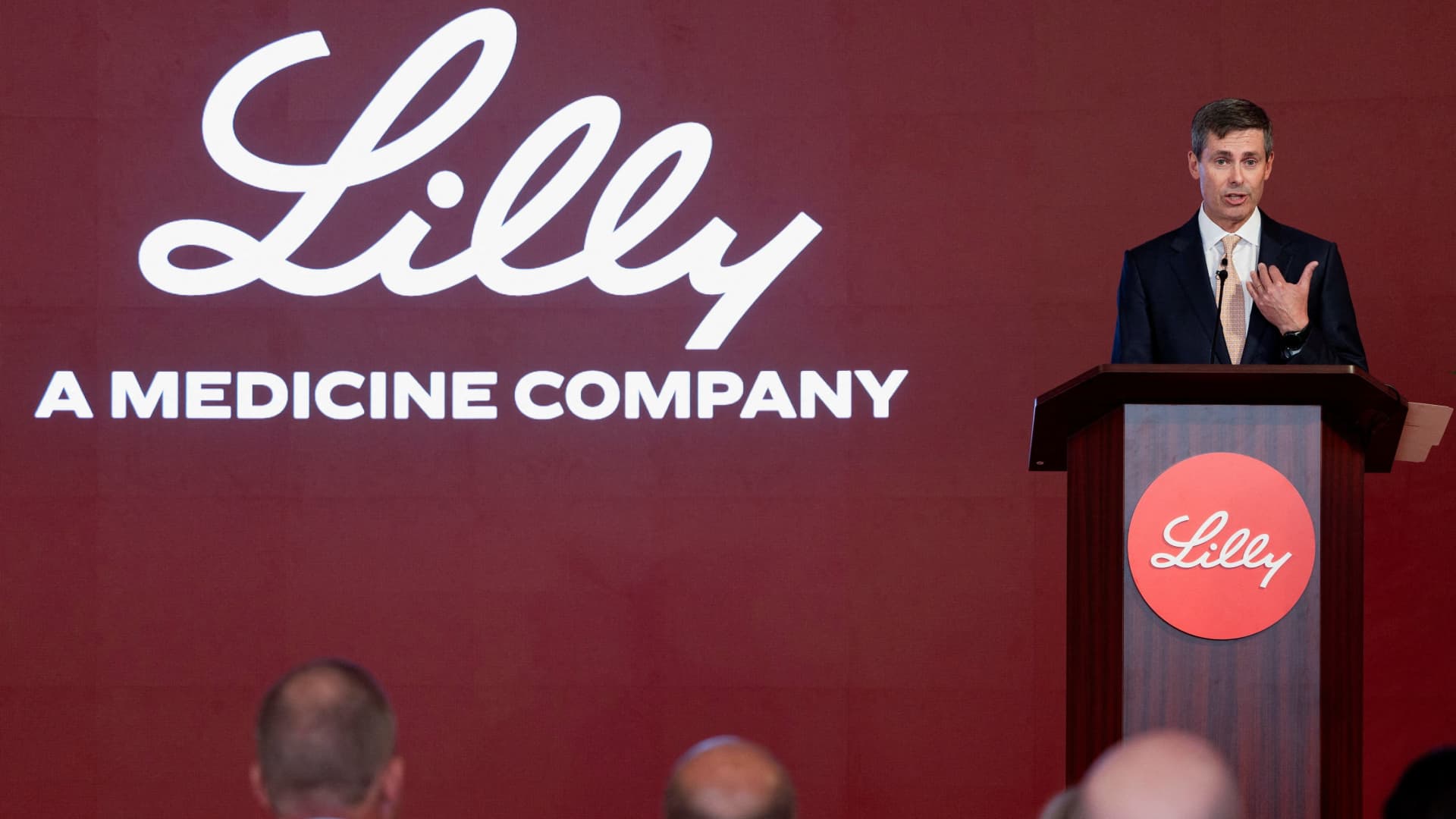
More than 20,000 people have started taking Eli Lilly‘s GLP-1 pill Foundayo in its first few weeks on the market, Lilly CEO Dave Ricks told CNBC on Thursday.
The FDA approved Lilly’s once-daily pill Foundayo earlier this month, making it the second oral GLP-1 drug behind Novo Nordisk’s Wegovy pill. Investors have been closely tracking weekly prescriptions for clues on how the launch is going.
More than 1,000 people are starting Foundayo a day, Ricks said in an exclusive interview with CNBC. He said it’ll take time to build the brand since it’s a new drug that doctors and patients don’t know. He contrasted it against the launch of the company’s Zepbound weight loss injection, which had the same active ingredient as its existing diabetes drug, Mounjaro, and against Novo’s Wegovy pill, which had the same brand name and active ingredient as the shot.
“So what we’re seeing now is basically organic demand, which is pretty strong to us,” Ricks said.
“This is going to play out over quarters, not days, and I just ask people to take a beat and let us execute,” Ricks said. “I think it’s going to be just fine.”
More than 80% of people taking Foundayo are new to GLP-1s, he said.
Ricks spoke to CNBC after Eli Lilly posted first-quarter earnings and revenue that easily beat expectations. Due to the timing of the launch, Foundayo was not included in the results.
During the quarter, sales of Mounjaro and Zepbound spiked 125% and 80%, respectively.
Eli Lilly is trying to maintain its dominance in the GLP-1 market following the successful launch of Novo Nordisk’s oral drug. It held a 60.1% share of the U.S. obesity and diabetes drug market in the first quarter, versus 39.4% for Novo Nordisk, according to an earnings presentation.
Packages of Ice Breakers spearmint mints Mints are displayed at a Costco Wholesale store on April 27, 2025 in San Diego, California.
Kevin Carter | Getty Images
Hershey is seeing higher sales for its mints and gum — thanks to the growing use of GLP-1 drugs.
“We’ve also seen strong demand for gum and mints, as the category benefits from functional snacking tailwinds, including GLP-1 adoption,” CEO Kirk Tanner said in pre-recorded remarks ahead of the company’s earnings conference call Thursday. “Retails sales for our third-largest confection brand, Ice Breakers, increased over 8% in the quarter.”
While Tanner didn’t specify why the increasing usage of GLP-1 agonists fueled mint and gum sales, some people who take medications like Ozempic, Wegovy and Mounjaro report experiencing halitosis, or bad breath. However, so-called Ozempic breath is not an official listed side effect for the medication.
Dental experts have linked the drugs to dry mouth, likely caused by dehydration and changes to saliva caused by the medication.
Hershey isn’t the only company known for its sweet treats that is reporting a surprising lift in sales from GLP-1 users. Swiss chocolatier Lindt & Spruengli said in March that U.S. sales of premium chocolate rose faster last year among people using the medication than those who weren’t.
And The Magnum Ice Cream Company told investors that data suggests that the growing adoption of GLP-1 drugs will likely boost sales of its more expensive products, like those that come in smaller portions or offer more protein or contain real fruit. It called the trend “the premium treat substitution effect.”
“As consumers using GLP-1s are eliminating [the] low-quality munching categories first, categories like premium chocolate, premium ice cream and protein snacks could gain share in the overall snacking market,” CEO Peter ter Kulve said on the company’s earnings conference call in February.
The boost to Hershey’s sales from breath-freshening mints and gum, as well as a 17% jump in sales of its protein bars, helped the company’s quarterly revenue climb more than 10% in the first quarter. However, shares were down more than 2% in morning trading.
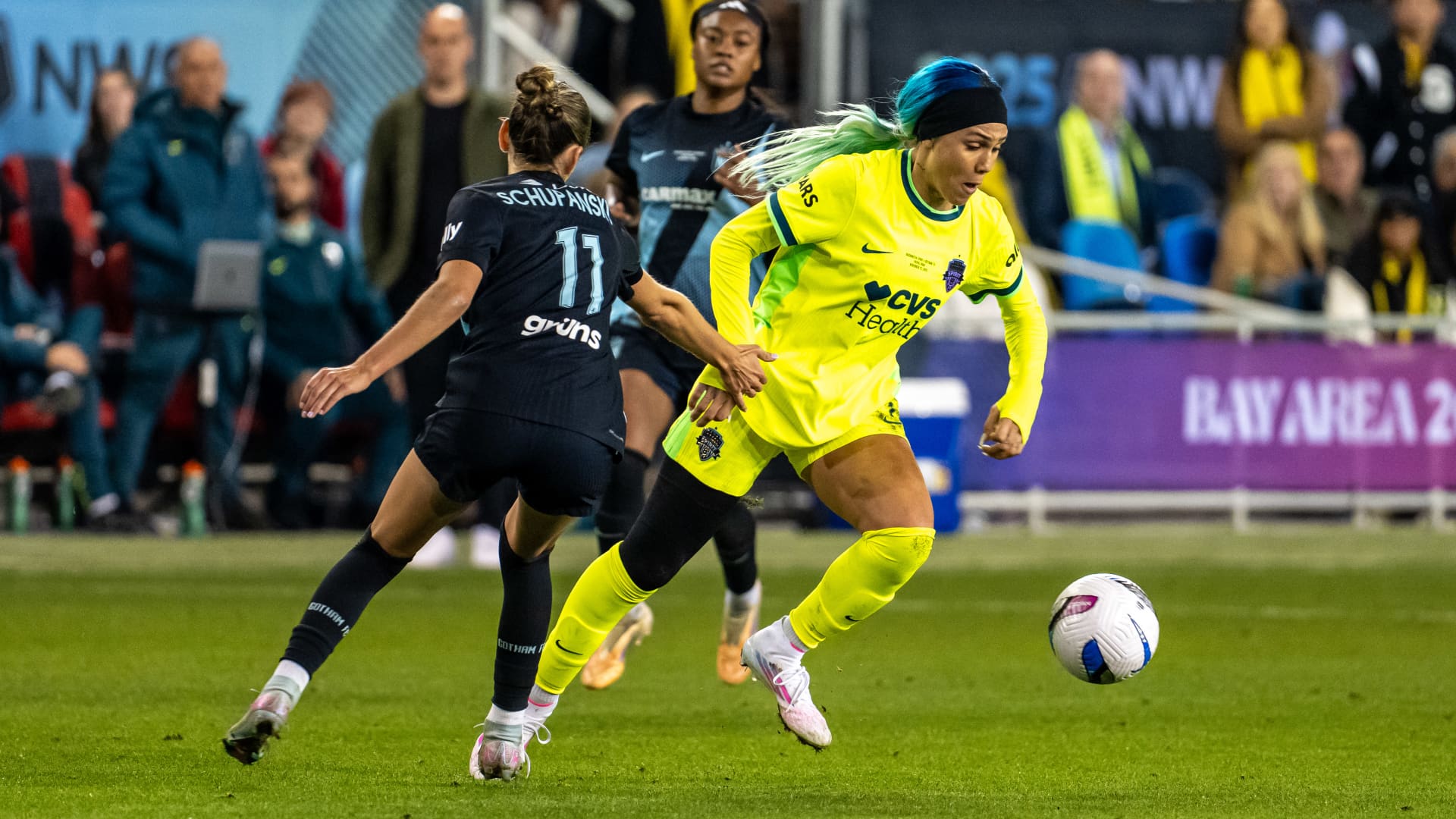
Trinity Rodman #2 of Washington Spirit evades Sarah Schupansky #11 of Gotham FC during the NWSL Championship 2025 final between Washington Spirit and NJ/NY Gotham FC at PayPal Park on November 22, 2025 in San Jose, California.
A version of this article first appeared in the CNBC Sport newsletter with Alex Sherman, which brings you the biggest news and exclusive interviews from the worlds of sports business and media. Sign up to receive future editions, straight to your inbox.
Last week, the National Women’s Soccer League awarded a new expansion franchise — in Columbus, Ohio — to an ownership group led by Haslam Sports Group for a fee of $205 million.
This represents a $40 million jump from the $165 million that billionaire Arthur Blank reportedly paid for the league’s Atlanta franchise in November. And that $165 million itself was a jump of $55 million from the reported $110 million fee Denver paid in January of last year.
Rewind to 2022, and the expansion fee for a new NWSL club was just $2 million.
On the surface, this appears to be a story about the NWSL’s growth. Postseason attendance rose 11% this past season, according to the league. Nearly 1.2 million people watched the NWSL finals, up 22% from a year ago, including a whopping 70% jump in the 18-to-34 demographic, the NWSL said.
It makes sense that investors would want to get in now given the league’s growth trajectory.
But, according to investors and bankers, something else is going on that’s affecting the NWSL’s valuations that has absolutely nothing to do with soccer. It has to do with a trickle-down investment thesis driven by the outsized businesses of the NFL and NBA.
Wealthy investors have long been interested in sports ownership, trophy assets that have also produced outsized returns on investment. The introduction of private equity investment, first adopted in the NFL in 2024, has added to the pool of possible buyers.
This dynamic is welcome news for the entire professional sports industry, which is also benefiting from another strategic investment play — the anti-artificial intelligence trade. Betting on live events is a counter-strategy for those who want less exposure to the tech in a market driven by AI investments.
That’s helped supercharge valuations of the most valuable sports teams in the U.S. According to CNBC Sport, the average NFL team is now valued at $7.65 billion. In 2010, NFL teams were worth, on average, about $1 billion.
Get the CNBC Sport newsletter directly to your inbox
The CNBC Sport newsletter with Alex Sherman brings you the biggest news and exclusive interviews from the worlds of sports business and media, delivered weekly to your inbox.
Subscribe here to get access today.
The average value of an NBA team is now $5.52 billion, 18% higher than a year ago. Fifteen years ago, the average NBA team was worth $369 million. That’s an increase of 1,396%. The S&P 500 is up about 422% over the same time period.
NBA and NFL ownership stakes are becoming too pricey for a class of buyers who have active interest in being a sports team owner — even at the minority stake level. Former New York Giants quarterback Eli Manning said as much in an interview with CNBC Sport last year.
“It’s too expensive for me,” Manning said of a potential minority stake in his longtime team. “A 1% stake valued at $10 billion turns into a very big number.”
Equity research firm Bernstein wrote in a recent note to clients that NFL team valuations have risen about 17 times in 25 years, “the kind of returns sufficient to give any portfolio manager a legendary status and easily trumping the S&P index or any emerging market index on the planet.”
The main cause of the valuation growth stems from the enormous size of the league’s media rights. The NFL signed an 11-year, $111 billion media rights deal in 2021 — and now wants even more money. The NBA followed with an 11-year, $77 billion deal of its own, starting with the 2025 season.
Splitting national TV dollars among teams allows even the lowest revenue teams — the NFL’s Arizona Cardinals and the NBA’s Memphis Grizzlies — to be valued at $5.9 billion and $3.75 billion, respectively, according to CNBC estimates.
There’s a fear that “second-tier” sports, including MLB and NHL, may be at risk of losing media rights dollars as the NFL flexes its muscle and asks for more from its media partners. The more money that goes to the NFL, the less money there is for everyone else.
One might expect that dynamic to negatively affect the valuations for those sports. But according to these bankers and investors, that’s not happening.
As the NBA and NFL have priced out buyers, there’s now increased demand for sports teams with more affordable valuations. That’s helped drive the recent NWSL surge, they say. There’s more liquidity at NWSL team price points, which has led to bidding wars and soaring valuations.
While the most recent winning buyers — Blank and the Haslams — are already owners of NFL and other sports teams, they’ve had to pay increasingly high prices to fight off other offers. There are far more buying groups willing to write a consortium check for $200 million than pay $1 billion or more for minority stakes in the biggest leagues.
“There’s a lot of demand to get into the sports business but people can’t write the checks to buy into the big four anymore. So what they’re doing is they’re substituting,” said veteran sports banker Sal Galatioto, president of Galatioto Sports Partners. “When supply is fixed and demand goes up, people will bid more to win. The underlying economics are not as important.”
The San Diego Padres are finalizing a sale for $3.9 billion, a record for MLB, despite the team’s regional sports network falling apart a few years ago. While nearly $4 billion is a lot of money, it’s still well below the average value of an NFL or NBA team.
“I’ve got investors coming up to me saying, ‘I can’t afford the NFL and NBA, what do you have for me in MLB, NHL?’” said one prominent sports banker, who asked to speak anonymously because the discussions were private.
The success of the NBA and NFL has funneled all the way down to the bottom of the sports food chain, said Rick Horrow, CEO of Horrow Sports Ventures.
“Major League Cricket was at $5 million. Now the value’s at $30 [million] and going higher. Major League Pickleball two years ago was at $5 million. Now the value is at $15 million or higher,” said Horrow.
Some of this sounds a little like a sports investment bubble, where valuations are divorced from the underlying financials of the leagues themselves.
That’s a real worry for smaller, less established leagues, said Jasmine Robinson, managing partner at Monarch Collective, the largest women’s sports investment fund, with $250 million to invest. It’s why Monarch has focused most of its funds on the WNBA and the NWSL, rather than more emergent leagues, Robinson said.
“Sports has historically been a great investment, but that’s really only for the biggest leagues. It’s not really like you can do any sports deal and you’re going to make money,” Robinson said. “There’s been real scarcity. You do need to be in the leagues that really are going to be leaders to make money. We wouldn’t make a bet on every women’s sports league.”
The big question may be what the threshold is for an established league if there’s an economic downturn that turns off the investment faucet. Monarch is betting the WNBA and the NWSL are above the line, but WNBA franchises have historically never made money, and now they need to pay out far more money to players after this year’s new collective bargaining agreement.
Rivian Automotive on Thursday said it has renegotiated a $6.57 billion loan from the U.S. Department of Energy down to $4.5 billion and is adjusting its production expectations at an under-construction plant in Georgia.
The DOE loan was previously set to support two phases of production for a total of 400,000 units annually. The amended loan covers one phase of production with a total capacity of 300,000 vehicles, the company said Thursday.
The changes enable Rivian to draw on the loan sooner and have greater initial production but lowers its total production capacity for the plant amid uncertain demand for all-electric vehicles.
The initial loan terms were negotiated under the Biden administration. It had been in limbo under the Trump administration, which has taken action to cut or reduce such loans and has pulled back government investments to promote EVs.
Rivian said it plans to tap into the loan in 2027, a year ahead of previously scheduled. The automaker also said production of the company’s upcoming R2 electric vehicle is on track to begin at the facility in late 2028, following its recent start to production at its current facility in Normal, Illinois.
Rivian CEO RJ Scaringe on Thursday told CNBC’s Phil LeBeau that any future expansion of the Georgia plant would be funded by the company, which has been raising capital through partnerships with companies such as Volkswagen and Uber.
The EV maker announced the new loan details in connection with its first-quarter results, which included a net loss of $416 million, or 33 cents per share, down from a loss of $541 million, or 48 cents per share, a year ago. Those per-share results were not comparable to Wall Street expectations.
Rivian’s revenue for the quarter was $1.38 billion, up from $1.24 billion a year earlier and slightly ahead of the $1.36 billion expected by analysts, according to LSEG.
The company’s gross profit, which is closely watched by investors, was $119 million — down $87 million during the first quarter compared with a year earlier. That included a $62 million loss for its automotive segment and a $181 million profit for its software and services division.
The decline in automotive profit was primarily due to a $100 million slump in sales of automotive regulatory credits and lower production volumes, Rivian said.
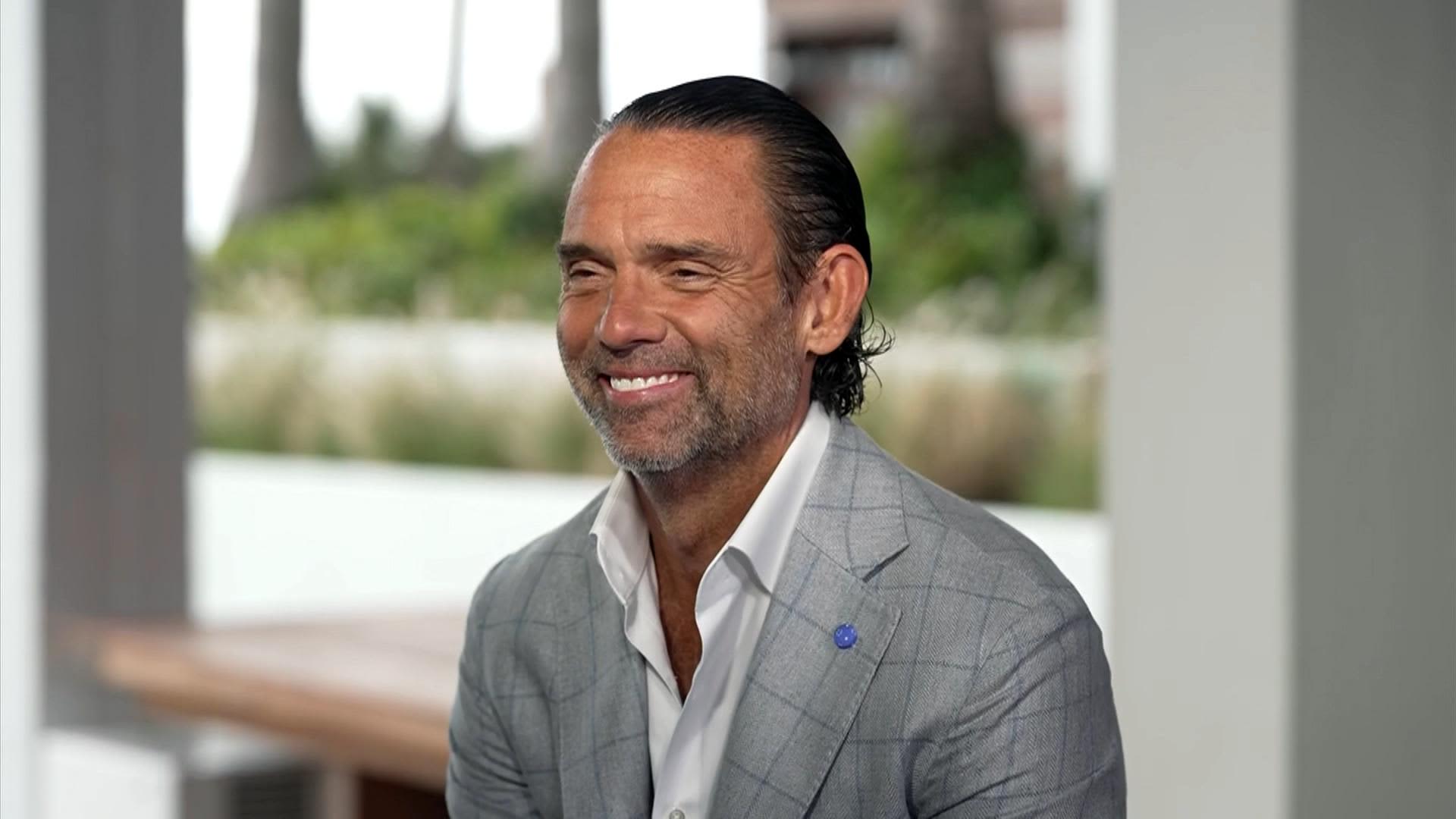
A potential pullback by Middle East sovereign wealth funds could drain hundreds of billions of dollars from the artificial intelligence boom and threaten key data center projects, according to tech investor Jack Selby.
Middle East investors — including sovereign wealth funds and government entities — account for roughly a quarter of global investments committed to AI over the next five years, said Selby, managing director of Peter Thiel’s family office, Thiel Capital. If the war in Iran drags on, and the United Arab Emirates, Saudi Arabia and other countries divert their investments to rebuilding at home, the lost capital could ripple through data centers as well as public and private tech companies, he said.
“I think markets have underappreciated how important the Middle East region is for capex spending as it relates to AI and AI infrastructure,” Selby told CNBC in an interview. “If the Middle East starts taking some of these projects offline or canceling some of these projects, the impact on the market could be much, much, much larger than what they currently suggest.”
Selby’s warning has implications for high-net-worth investors, family offices and funds betting on the AI trade. A Wall Street Journal report this week about missed revenue targets at OpenAI rattled tech and chip stocks. Selby said the Middle East poses another funding risk, as AI companies grew more dependent on the region for capital.
Oracle,Nvidia and Cisco are part of OpenAI’s campus in the UAE to build out 5 gigawatts of capacity. Microsoft plans to invest $15 billion in the UAE by 2029. The sovereign wealth funds of the UAE and Saudi Arabia have become key investors in private AI companies, with OpenAI reportedly seeking $50 billion from the big funds in the region earlier this year.
Get Inside Wealth directly to your inbox
Selby estimates that half of the Middle East’s AI funding is dedicated to data centers located in the region. The other half is allotted to projects and data centers worldwide. Middle East funds and companies have already started canceling various shipping and business contracts by invoking force majeure, he said. The big risk is that they start canceling data centers as well.
“Markets don’t seem to grasp that this is a very real situation,” he said. “It’s very volatile. I hope and I pray that it goes back to some semblance of normalcy soon. But it seems to me that markets are underpricing this volatility and the risk.”
Beyond the war, AI also faces a broader risk of overinvestment and speculation, Selby said. Like the dot-com bubble, he said investors and founders are bidding up values of AI and infrastructure companies indiscriminately. He said the AI boom is consuming far more capital, with the top hyperscalers expected to spend more than $700 billion this year. So the wealth destruction will overshadow the losses of the dot-com bust.
“AI is a revolutionary technology, don’t get me wrong,” he said. “But it can also be an exceptional bubble. There will be extreme winners and there also be some real losers. And those losers will be orders of magnitude larger than any of the losers that we’ve seen before. The AI bubble, when it busts, will be at least one more zero, probably two and three more zeros than the dot-com bubble. That will be tens, if not hundreds, of billions of dollars.”
He cited Google as an example from the dot-com era. While investors were bidding up the values of Ask Jeeves, Infoseek, AltaVista and other early search functions, Google came along and upended all their business models. He said similar disruptions could happen to today’s AI leaders.
Selby’s AI strategy is to avoid the crowds. With a second fund he’s launching at Copper Sky, his Arizona-based VC fund, Selby is targeting tech firms outside of California, New York and Massachusetts. He said tech firms in those three states — especially the Stanford and MIT clusters — are attracting all the capital and attention. So the best values lie elsewhere, he said.
“Probably 90%-plus of all venture capital investment went to California, New York, Massachusetts, an all-time high,” he said. “The good news is you get outside of those three states and go to the other 47 states, the deals, the investment opportunities are far, far, far less expensive, and that’s what we do.”
Selby declined to give many details on Thiel’s family office, saying only that Thiel invests in great founders rather than specific industries. Thiel Capital, which ranked on the Inside Wealth Family Office 15 list of most active family office investors, has invested in everything from German drone makers (Stark) and gene therapy startups (Kriya Therapeutics) to an AI hiring company (Mercor) and space research firm (Varda).
Yet as a family office director and head of a VC fund that raises money from family offices, Selby said the biggest mistake for many family offices today is making their own direct investments. A survey from Citibank last year found that seven out of 10 family offices have made direct investments in private companies, without going through a fund.
Selby said he understands why family offices are striking out on their own, given the dismal performance of private equity and venture capital funds and lack of distributions. He said two-thirds of venture capital firms are “zombie VCs,” that aren’t raising or returning money and should close.
“Family offices are so frustrated with people like ourselves, who have not been returning their capital, so why shouldn’t they try it themselves?” Selby said. “They couldn’t do any worse than a lot of what [VCs] have been doing in terms of making investments, not giving money back, having marks on paper.”
At the same time, however, he said typical family offices aren’t adequately trained in assessing, valuing and restructuring private companies. Many ultra-wealthy investors are more motivated by status and peer pressure than by disciplined returns.
“When these fancy people go to their cocktail parties in Manhattan, they have to have something interesting to talk about,” he said. “All of their friends are talking about some version of [direct investments]. So they have to have something to add to the conversation. So therefore, they do the same thing. The Greek shipping magnate that lives in Manhattan knows nothing about rocketry. So why is he investing in SpaceX? Because he just wants to have something fun to talk about at the fancy cocktail party.”
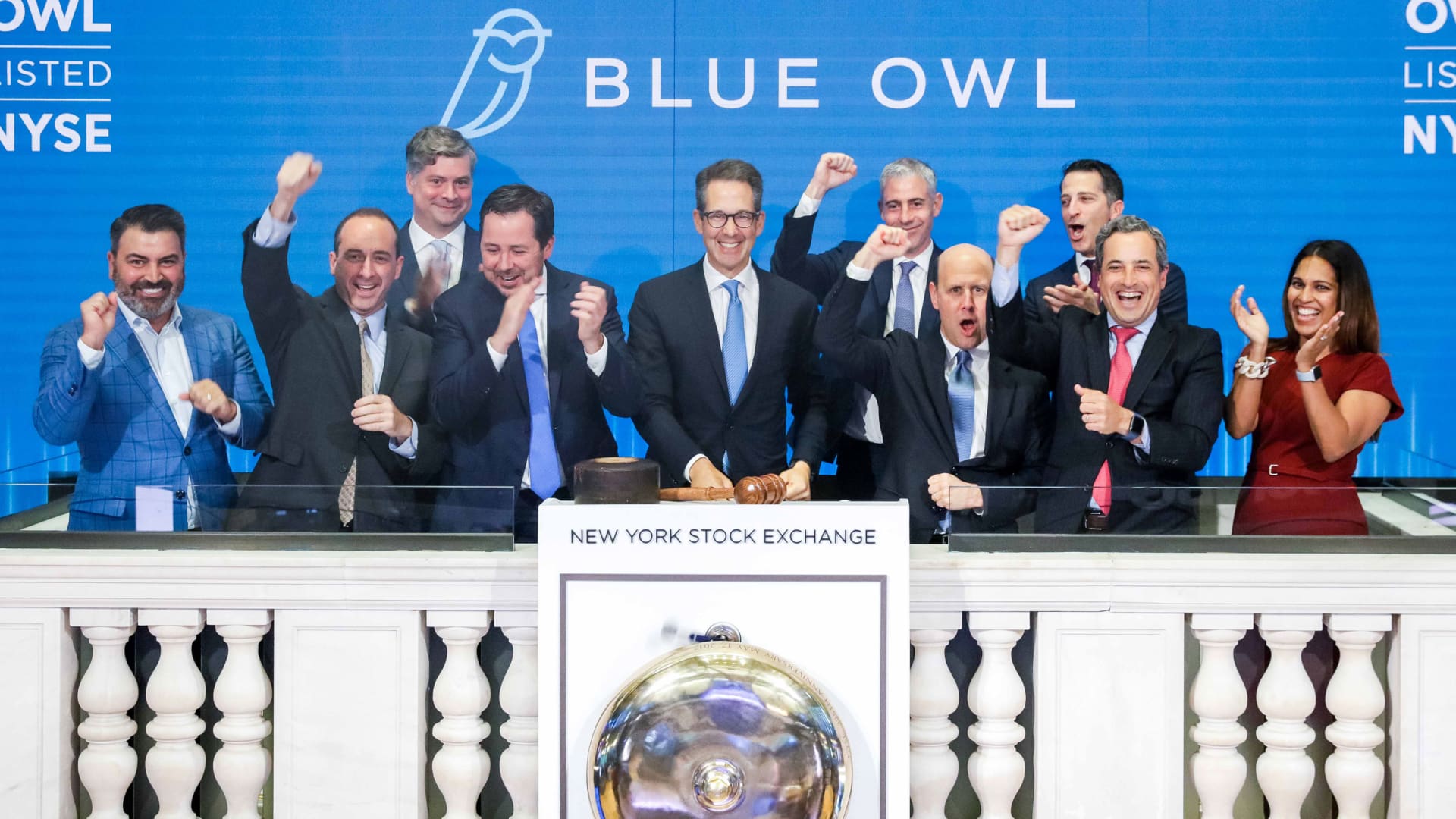
Blue Owl Capital at the New York Stock Exchange, May 20, 2021.
Source: NYSE
Shares of Blue Owl, the private credit firm at the center of recent jitters over exposure to software companies, jumped 10% in trading Thursday after executives disclosed sizable gains tied to SpaceX.
“We made about 10 times our money on that investment,” an executive said on the firm’s first-quarter earnings call.
Blue Owl has already sold roughly half its position at a $1.25 trillion valuation and continues to hold the remainder, he said.
The call was hosted by Marc Lipschultz, co-chief executive officer, and Alan Kirshenbaum, chief financial officer. It wasn’t immediately clear which executive spoke specifically about the SpaceX investment.
The gains on SpaceX, which is headed toward what may be the largest IPO in history later this year, could offset potential losses elsewhere in Blue Owl’s portfolio if software companies default, the executive said.
While private credit funds are composed mostly of loans, they can also hold preferred and common shares in companies.
“We made a loan to the company, and had the privilege of getting to know them very well and then participating in ongoing conversations about other financing opportunities, and ultimately, in this case, an equity investment,” the Blue Owl executive said of SpaceX.
A few minutes later, Blue Owl management noted that while loan-to-value rates have deteriorated amid the software slump, there is still a “tremendous amount of remaining cushion” before losses are seen.
This story is developing. Please check back for updates.
The headquarters of the U.S. Food and Drug Administration in Silver Spring, Maryland, Nov. 4, 2009.
Jason Reed | Reuters
The Food and Drug Administration on Thursday proposed excluding the active ingredients in Novo Nordisk and Eli Lilly‘s blockbuster obesity and diabetes medications from the list of drugs that outsourcing facilities can use for compounding in bulk.
If that proposal is finalized, the exclusion would likely limit the mass compounding — or the making of custom, often cheaper alternatives — of those medicines unless they appear on the FDA’s drug shortage list. The agency said it will consider public comments, which can be submitted until late June, before making a final decision.
The FDA finds “no clinical need” for outsourcing facilities to compound them from bulk drug substances, the agency said in a release.
The proposal includes semaglutide, the active ingredient in Novo’s obesity drug Wegovy and diabetes counterpart Ozempic, and tirzepatide, which is in Lilly’s weight loss injection Zepbound and diabetes shot Mounjaro. It also covers Novo’s older molecule liraglutide.
“When FDA-approved drugs are available, outsourcing facilities cannot lawfully compound using bulk drug substances unless there is a clear clinical need,” FDA Commissioner Marty Makary said in the release.
The agency’s proposal specifically targets 503B outsourcing facilities, which manufacture compounded drugs in bulk with or without prescription and are largely regulated by FDA guidelines.
The proposal does not impact 503A pharmacies, which make compounded drugs according to individual prescriptions for a specific patient and are largely regulated by states rather than the FDA.
Lilly and Novo have invested billions to ramp up manufacturing capacity over the last several years, which has helped alleviate supply constraints. The companies have also pursued efforts to make their branded medications more affordable to win over users who had flocked to cheaper compounded medications.
Displeased couple having problems during a meeting with their agent in the office.
Skynesher | E+ | Getty Images
A version of this article first appeared in CNBC’s Inside Wealth newsletter with Robert Frank, a weekly guide to the high-net-worth investor and consumer. Sign up to receive future editions, straight to your inbox.
Lawyer Tasha Dickinson said she gets calls every week from clients asking about legal advice they got from ChatGPT, Claude or another artificial intelligence chatbot. Some don’t admit it, but she can tell from their line of questioning, she said.
One client, a high-net-worth Florida resident, asked Dickinson about creating a community property trust — an attractive option for married couples — saying he got the suggestion from AI to save on taxes for his heirs, she said. Dickinson quickly pointed out a problem: The client’s wife had recently died.
“I said, ‘Well, you do understand that a community property trust is between husband and wife, right?’ And there was silence on the phone,” said Dickinson, a partner at Day Pitney. “‘They’re like, ‘Oh, well, AI thought it was a good strategy.’ Well, like, in the universe, maybe it’s a good strategy, but it’s not a good strategy for you.”
Lawyers to the wealthy told Inside Wealth that their clients are increasingly using AI not only to research tax topics but to second guess their lawyers’ advice. While some lawyers said AI helps clients come up with informed questions and learn basic concepts, they also say it poses a headache and legal risks.
Robert Strauss, partner at Weinstock Manion, said several clients have uploaded trust documents to AI systems and come back with a list of questions and suggested edits, forcing Strauss to defend his work and explain why the AI recommendations aren’t appropriate for the client’s situation.
“The questions are fine, but it results in spending more time on the matter than we would ordinarily spend,” he said. “We end up spending two, three, four hours of time dealing with stuff that so far has amounted to nothing. I have not actually received a single workable suggestion from that process.”
The result, he said, is a lack of trust on the part of the client in their lawyer.
What’s more troubling, Strauss said, is that clients are sharing sensitive information with large-language models, raising data privacy concerns and legal pitfalls. Strauss said his firm is currently revising their client contract to warn clients that using AI chatbots like this can void attorney-client privilege.
In February, a federal judge ruled that a criminal defendant’s conversation with Claude about his legal defense strategy were not protected by attorney-client privilege.
“What’s keeping me awake at night as it relates to AI? It’s not that AI is sometimes wrong, because I can correct those mistakes. And it’s not that people are double-checking my work on AI, because I have a lot of confidence in my work,” Dickinson said. “What I am concerned about is that when people put documents and do these searches into AI, they’re waiving the attorney-client privilege, and that is a huge issue.”
Dan Griffith, director of wealth strategy at Huntington Bank, warned that asking a chatbot how to protect your assets with a prenuptial agreement or how to sell your business while paying less in taxes, for example, could be used against you in court.
Get Inside Wealth directly to your inbox
While high-net-worth clients can generally access — and afford — the best legal advice, they, like the rest of us, enjoy the convenience of AI, according to Griffith.
Dickinson added that the cost savings are still a draw. (“It’s not fun to pay for professional services,” she said.) She added that many of her clients are confident entrepreneurs.
“A lot of our clients have been so successful. I mean, they’re smart, right? And they have a drive for knowledge,” she said. “I think some err on the side of assuming that they understand more about this than they actually do.”
Using these AI tools, she said, “gives a false sense of knowledge.”
In some ways, this isn’t a new problem. Clients often bring suggestions to their lawyer that they got from a country club friend or an article. Dickinson described it as “a more evolved form of cocktail party talk.”
And the trend isn’t one-sided. Many lawyers use AI in their professional and personal lives. This has led to headline-making blunders like briefs with fake citations.
But few clients are familiar enough with AI and the law to write an effective prompt, lawyers said.
Ed Renn of Withers gave the example of a client who wanted to transfer unlimited assets to his spouse upon ChatGPT’s advice. The client, however, didn’t mention his wife was foreign-born, which means he couldn’t take advantage of the unlimited marital deduction without a special type of trust, according to Renn.
“If you don’t know quite what you’re doing, it’s garbage in, garbage out,” he said.
Renn added that AI tools appear to make more mistakes with more complex topics like international taxes and aren’t up to date with new legislation or guidance from the Internal Revenue Service.
Griffith said that deciding how to transfer your wealth to your loved ones requires a more complicated discussion than ChatGPT is prepared for. There are rarely easy answers when deciding, for instance, how to divide assets between children from a first marriage and a second spouse, he said.
“If your client asks, ‘Hey, if I do this trust, will my son have access to the funds that I give him at some point in time?’ The answer shouldn’t be ‘yes’ or ‘no.’ The answer should be, ‘Tell me more about your relationship with your son, or what’s the situation like?’” he said. “AI tends to be very solution-oriented and tries to find some way to get to yes. It doesn’t do a good enough job of saying, ‘You know what? Let’s get to the core of what your question is.’”